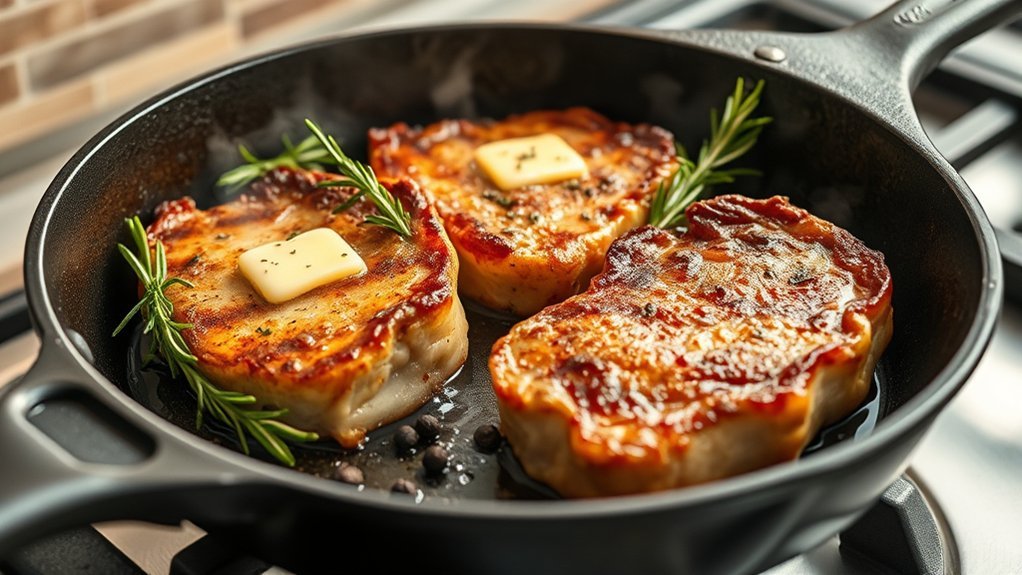

You want to cook veal chops that are tender, juicy, and full of flavor, and using a cast iron skillet is one of the best methods to achieve that. Cooking veal chops in a cast iron skillet allows for excellent heat retention and even cooking, which is essential for great results. The key lies in precise temperature control, proper seasoning, and timing to avoid overcooking.
With the right technique, you’ll develop a perfect sear and a delicate interior. But before you start, understanding the preparation and skillet handling is essential to get it right. Following these steps will help you master the art of cooking veal chops in a cast iron skillet every time.
Key Takeaways
- Preheat cast iron skillet evenly to 400°F to 450°F to ensure optimal Maillard reaction and even searing of veal chops.
- Choose 1 to 1.5-inch thick bone-in veal chops with trimmed veins and consistent pink hue for balanced cooking and flavor retention.
- Season veal chops with rosemary, thyme, garlic, salt, and pepper just before searing for enhanced natural flavor without overpowering.
- Sear chops on medium-high heat using high smoke point oil, flipping once to develop an even crust and lock in juices.
- Rest cooked veal chops 5 to 10 minutes loosely covered to redistribute juices, ensuring tenderness and preserving moisture.
Why Veal Chops Are Perfect for Cast Iron Cooking
Why do veal chops excel when cooked in a cast iron skillet? The answer lies in the skillet’s superior heat retention and even distribution, which allow you to achieve an ideal Maillard reaction without overcooking. This precise searing locks in the delicate texture and subtle flavor derived from careful veal sourcing.
As you cook, the skillet facilitates the development of fond, those caramelized bits essential for authentic pan sauce terminology. You can deglaze the pan directly, harnessing these concentrated flavors to create a rich, balanced sauce that complements the veal’s tenderness.
The cast iron’s ability to maintain consistent temperature is crucial, ensuring that the veal chop’s lean muscle fibers don’t toughen, preserving its signature juiciness and nuanced taste profile.
Choosing the Best Veal Chops for Your Skillet
How do you select veal chops that will perform best in a cast iron skillet? Start by prioritizing thickness. Aim for 1 to 1.5 inches to ensure even cooking and optimal searing.
Prioritize veal chop thickness between 1 and 1.5 inches for perfect even cooking and searing.
Pay close attention to bone selection. Chops with a T-bone or rib bone retain moisture and add flavor during high-heat cooking.
Inspect the meat for proper vein trimming, removing any excess connective tissue or sinew that can cause toughness or uneven cooking. Opt for chops with a consistent pink hue and fine marbling, as this balances tenderness and flavor without excess fat.
Avoid overly thin or irregularly shaped chops, as they cook unevenly in cast iron. Choosing well-trimmed, bone-in veal chops ensures superior heat retention and flavor development in your skillet.
Seasoning and Marinating Veal Chops
You’ll want to season veal chops with spices like rosemary, thyme, and garlic to enhance their natural flavor. For marinating, use a balanced mix of acid, oil, and aromatics such as lemon juice, olive oil, and crushed peppercorns to tenderize and infuse the meat.
Keep marinating time between 30 minutes and 2 hours to avoid overpowering the delicate texture.
Best Veal Chop Spices
Which spices elevate veal chops to their fullest flavor potential? Focus on refined spice pairing that complements veal’s delicate taste without overpowering it. Classic choices include ground black pepper, garlic powder, and smoked paprika, which add depth and subtle heat.
For herb blends, rosemary, thyme, and sage are indispensable. They enhance umami and impart aromatic complexity. Use these herbs fresh or dried, but finely chopped to ensure even distribution.
Balance is key; avoid excessive salt at this stage if you plan to marinate. Apply spices evenly to both sides of the chop before searing in your cast iron skillet for optimal crust development. This carefully calibrated seasoning approach guarantees a flavorful, tender result that highlights veal’s natural characteristics.
Marinade Ingredients To Use
Building on the careful selection of spices, incorporating the right marinade ingredients can further enhance veal chops’ tenderness and flavor complexity. You want ingredients that promote a juicy texture while maintaining flavor balance, avoiding overpowering the meat’s natural subtlety. Acidic components break down proteins, oils retain moisture, and aromatics infuse taste.
| Ingredient | Purpose | Effect on Veal Chops |
|---|---|---|
| Lemon juice | Acid for tenderizing | Softens meat, adds brightness |
| Olive oil | Moisture retention | Ensures juicy texture |
| Garlic & herbs | Flavor infusion | Enhances aromatic complexity |
Selecting these ingredients ensures your veal chops develop a refined flavor profile with optimal tenderness and juiciness.
Marinating Time Guidelines
Although veal chops benefit from marination, the timing must be carefully controlled to preserve their delicate texture and subtle flavor. Optimal marinating duration ranges between 30 minutes and 2 hours.
Exceeding this timeframe risks protein breakdown and a mushy texture due to acidic components. When selecting flavor pairings, choose mild herbs and citrus to complement rather than overpower the veal’s natural taste.
Acidic elements like lemon juice or vinegar should be used sparingly to avoid excessive tenderization. Maintain consistent refrigeration throughout marinating to inhibit bacterial growth.
Always discard used marinade or bring it to a boil if repurposing as a sauce. By adhering to these marinating time guidelines, you’ll enhance veal chops’ flavor without compromising their structural integrity.
Preheating Cast Iron Skillet for Perfect Veal Chop Searing
You need to preheat your cast iron skillet evenly to ensure consistent searing across the veal chop surface. Maintain the skillet temperature between 400°F and 450°F for optimal Maillard reaction without burning.
Test readiness by flicking a few drops of water. If they sizzle and evaporate immediately, your skillet is properly heated.
Importance Of Even Heating
A properly preheated cast iron skillet guarantees even heating, which is essential for achieving a perfect sear on veal chops. The pan material’s high thermal mass distributes heat uniformly, preventing hot spots that cause uneven cooking.
When you allow the skillet to reach a consistent temperature, the surface efficiently caramelizes the meat’s exterior, locking in juices and flavor.
| Factor | Impact on Cooking |
|---|---|
| Even Heating | Uniform sear, no burnt spots |
| Pan Material | Retains heat steadily |
| Preheating Time | Ensures temperature stability |
Optimal Temperature Range
How hot should your cast iron skillet be to achieve the ideal sear on veal chops? You need to preheat the pan to a surface temperature between 400°F and 450°F. This range leverages pan heat dynamics effectively, ensuring rapid Maillard reaction without burning.
Below 400°F, the sear develops poorly, causing excessive moisture loss. Above 450°F, you risk compromising the seasoning science, where the seasoning layer can degrade, affecting both flavor and skillet longevity.
Maintaining this temperature window optimizes heat transfer, promoting an even crust and retaining internal juiciness. Use consistent medium-high heat to allow the skillet’s thermal mass to stabilize, ensuring that when you add the veal chops, the surface temperature doesn’t drop drastically, preserving the perfect sear every time.
Testing Skillet Readiness
When exactly is your cast iron skillet ready for searing veal chops? You’ll know when the surface reaches the optimal temperature range established earlier, typically between 400°F and 450°F.
To test readiness, sprinkle a few drops of water onto the skillet. If they sizzle and evaporate immediately, your skillet is hot enough. Avoid the irrelevant discussion about color changes or smoke patterns; these are nonessential reminders that don’t guarantee searing precision.
Instead, rely on direct temperature feedback through water behavior or an infrared thermometer for accuracy. Preheating thoroughly ensures an even sear and prevents sticking.
How to Cook Veal Chops in a Cast Iron Skillet
Cooking veal chops in a cast iron skillet demands careful temperature control and timing to achieve a perfect sear while maintaining tenderness. Preheat your skillet over medium-high heat until it reaches optimal temperature, ensuring a sizzling surface for immediate browning. Pat the chops dry to prevent steaming and season precisely.
Use a high smoke point oil to avoid burning and adhere strictly to kitchen safety protocols. Handle hot surfaces cautiously and avoid cross-contamination. Place chops firmly in the skillet without overcrowding to maintain consistent heat distribution.
Flip only once to develop an even crust. While mastering veal, consider vegan substitutes to practice skillet techniques safely before progressing to meat. This method guarantees a balanced Maillard reaction, locking in juices and flavor, ensuring your veal chops cook evenly and retain their delicate texture.
Checking Doneness for Tender Veal Chops
Although veal chops cook quickly, you’ll need to monitor their internal temperature closely to ensure tenderness without overcooking. Use an instant-read thermometer inserted near the bone for accurate readings, avoiding direct contact with the bone to prevent false highs.
Aim for 145°F (63°C) for medium-rare doneness; this temperature preserves the delicate vein contrast that indicates properly cooked meat. When checking doneness by touch, practice careful bone handling to avoid burns and to assess firmness precisely.
The chop should yield slightly under pressure but resist softness typical of raw meat. Visual cues, such as the subtle pink hue near the bone, complement temperature checks. Combining these methods ensures you retain the veal’s tender texture and optimal flavor without crossing into dryness.
Why Resting Veal Chops Is Crucial and How to Do It Right
You need to rest veal chops to allow the internal juices to redistribute, ensuring ideal tenderness and flavor. Skipping this step causes those juices to escape, resulting in a dry chop.
To rest properly, let the meat sit loosely covered at room temperature for 5 to 10 minutes before serving.
Importance Of Resting
While it may be tempting to serve veal chops immediately after cooking, resting them is essential to guarantee optimal juiciness and tenderness. Resting allows the meat’s internal juices to redistribute evenly, preventing them from escaping when cut.
Skipping this step leads to dry, less flavorful chops, an error unrelated topic discussions often overlook. It’s not an extraneous concept but a critical phase in meat preparation that impacts texture and moisture retention.
Resting also stabilizes internal temperature, ensuring continued gentle cooking without overcooking. By respecting this step, you preserve the chop’s structure and maximize your cast iron skillet’s searing benefits.
Understanding the importance of resting elevates your culinary results and distinguishes your technique from common rushing mistakes.
Proper Resting Techniques
How long should you rest veal chops to achieve perfect tenderness? Resting for 5 to 10 minutes is critical after using the pan sear technique. This pause allows juices, redistributed by seasoning science and heat, to settle evenly within the meat fibers, preventing moisture loss when sliced.
Follow these precise steps for proper resting:
- Remove veal chops from the skillet immediately after searing.
- Place them on a warm plate to retain heat.
- Tent loosely with foil to avoid cooling while preventing condensation.
- Wait 5-10 minutes before carving to ensure optimal juiciness and texture.
Quick Flavor Tips for Cooking Veal Chops
A few strategic flavor enhancements can elevate the natural tenderness of veal chops and complement their delicate taste. Start by seasoning with fine sea salt and freshly ground black pepper just before cooking to avoid drawing out moisture prematurely.
Incorporate fresh herbs like rosemary or thyme during the final minute of searing for aromatic complexity without overpowering the meat. A light brush of clarified butter aids in achieving a rich crust and prevents burning.
Avoid unrelated topic distractions such as elaborate sauces that mask veal’s subtlety. When planning your kitchen design, ensure your cast iron skillet is easily accessible, enabling precise temperature control and timely flavor additions.
These measured steps guarantee you highlight veal’s unique profile efficiently and with confidence.
Mistakes to Avoid When Cooking Veal Chops
Why do some veal chops turn out tough or unevenly cooked? It’s often due to preventable mistakes. To achieve tender, perfectly cooked chops, avoid these pitfalls:
- Skipping temperature control: Overheating the cast iron leads to burnt exteriors and raw interiors. Use medium-high heat for even cooking.
- Not resting the meat: Cutting immediately releases juices, causing dryness. Let chops rest for 5 minutes.
- Ignoring seasoning balance: Over-salting masks veal’s delicate flavor; under-seasoning yields bland results.
- Overcomplicating with vegan alternatives: While plant-based options are great, don’t confuse their cooking methods with veal’s unique needs.
Master these, and your veal chops won’t just impress. Your dessert pairings will shine after a flawless entrée.
Serving Veal Chops for a Restaurant-Quality Meal
Perfectly cooked veal chops deserve a presentation that matches their quality. To elevate your dish to restaurant standards, focus on plating, complementary sides, and texture contrasts. Incorporate alternative crusts like crushed nuts or gluten free breadcrumbs to add crunch without gluten.
Pair with seasonal vegetables or a light sauce to balance richness.
| Component | Recommendation |
|---|---|
| Crust Options | Almond crust (gluten free), Herb crust |
| Side Dishes | Roasted asparagus, Garlic mashed potatoes |
| Sauces | Lemon butter, Red wine reduction |
Serve veal chops resting briefly to retain juices. Arrange sides neatly, and drizzle sauce just before serving. This approach ensures a visually appealing, texturally balanced meal that rivals top restaurants.
Frequently Asked Questions
Can I Freeze Veal Chops Before Cooking?
Yes, you can freeze veal chops before cooking. For optimal freeze prep, wrap them tightly in plastic wrap and foil.
Follow storage tips by labeling the date and using within 3-4 months to maintain freshness and quality.
What Side Dishes Pair Best With Veal Chops?
Imagine tender veal chops beside creamy mashed potatoes and sautéed asparagus; these side dish pairings enhance flavor balance.
Complement them with light-bodied Pinot Noir or crisp Chardonnay for ideal wine options, elevating your meal’s sophistication and harmony.
How Long Can Cooked Veal Chops Be Stored?
You can store cooked veal chops in the refrigerator for up to 3-4 days. For longer storage duration, freeze them, and they’ll remain safe and maintain quality for 2-3 months.
Always refrigerate within two hours.
Is Veal Healthier Than Other Meats?
You’ll find veal nutrition offers lean protein with lower fat than beef, benefiting heart health. Compared to other meats, veal provides essential vitamins like B12 and minerals, making it a healthier choice in strict health comparisons.
Can I Use Olive Oil Instead of Butter for Cooking?
Yes, you can use olive oil as a butter substitute. It has a higher smoke point, making it ideal for searing veal chops in cast iron, and it imparts a subtle, fruity flavor without compromising texture or browning.
Conclusion
Mastering veal chops in your cast iron skillet transforms dinner into a culinary event worthy of royalty. By preheating properly, seasoning with precision, and searing to a perfect medium-rare 145°F, you’ll unleash flavors that could make even the most seasoned chefs jealous.
Remember to rest the meat to preserve juiciness and finish with a pan sauce for that extra punch. Follow these steps, and you’ll consistently serve chops so tender, they practically melt on your fork.
With these techniques, cooking veal chops in a cast iron skillet will become your go-to method for a delicious and impressive meal every time.