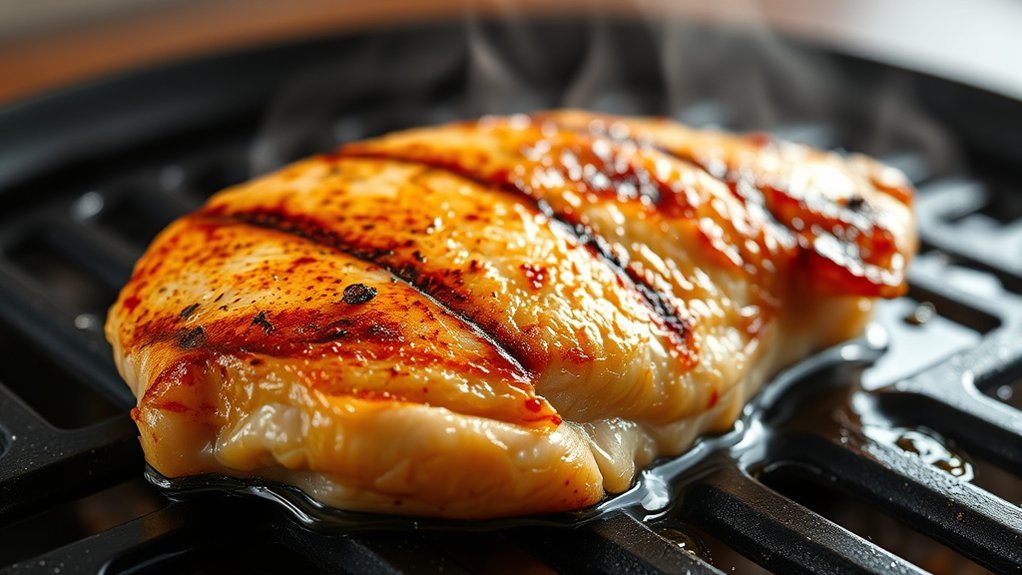

Picture the sizzle of chicken breast meeting a hot griddle, the surface searing to a golden crust while the inside slowly reaches the perfect temperature.
Knowing how long to cook chicken breast on a griddle is essential for achieving juicy, flavorful results.
You might think timing is simple, but thickness, thaw state, and heat control all play critical roles.
Getting it just right means balancing these factors precisely, ensuring juicy, safe results every time.
Before you cook, you’ll want to understand how to master these variables for consistent success.
Key Takeaways
- Thin chicken breasts cook about 4-6 minutes per side on a griddle at 350°F to 375°F.
- Thicker breasts need approximately 8-12 minutes total, adjusting time per side for even cooking.
- Partially thawed chicken requires 50% more cooking time than fully thawed pieces.
- Frozen chicken breasts need extended cooking time; always verify doneness with a meat thermometer.
- Ensure internal temperature reaches 165°F for safe consumption, using an instant-read thermometer.
How Chicken Size and Thickness Affect Griddle Cooking
How does the size and thickness of your chicken breast influence the cooking time on a griddle? Larger or thicker pieces require more time to reach the safe internal temperature of 165°F, essential for chicken safety.
Thicker breasts slow heat penetration, making even heat distribution critical to avoid undercooked centers or overcooked exteriors. On a griddle, you must adjust cooking time according to thickness; thin cuts may take 4-6 minutes per side, while thick ones can need 8-12 minutes.
Uneven thickness causes uneven cooking, risking foodborne illness. Monitoring thickness ensures you apply the right heat level and duration, optimizing heat distribution and maintaining juiciness. Using a meat thermometer helps guarantee chicken safety regardless of size, preventing undercooking or drying out.
How to Prep Chicken Breast for Even Cooking on a Griddle
To guarantee even cooking on your griddle, start by selecting chicken breasts that are similar in size and shape. Use a meat mallet to pound the breasts to a uniform thickness, which prevents uneven cooking and dryness.
Finally, apply seasoning or marinate the chicken to enhance flavor and maintain moisture during cooking.
Selecting Uniform Chicken Breasts
Why does selecting uniform chicken breasts matter when cooking on a griddle? Uniformity in size and thickness ensures consistent heat distribution, which is critical for achieving uniform browning and an even sear.
When breasts vary significantly, thinner parts cook faster, risking dryness, while thicker sections remain undercooked. By choosing chicken breasts that are similar in thickness and weight, you maintain control over cooking time and temperature, preventing uneven cooking.
This uniformity minimizes the need for constant adjustment and flipping, streamlining the process. Inspect each piece carefully, selecting those with consistent dimensions and surface area. This technical approach optimizes the griddle’s heat transfer efficiency, resulting in evenly cooked chicken with a desirable texture and appearance.
Properly Pounding For Thickness
Ensuring your chicken breasts are uniform in size is only the first step; you also need to address variations in thickness to promote even cooking on the griddle. Use a proper pounding technique by placing the breast between two sheets of plastic wrap or in a resealable bag.
Gently pound from the center outward with a meat mallet or rolling pin to achieve thickness consistency without tearing the meat.
| Step | Purpose |
|---|---|
| Wrap in plastic | Prevents mess and tearing |
| Pound from center | Ensures even thickness |
| Check thickness | Confirms uniformity |
This method helps the chicken cook evenly, avoiding overcooked edges or undercooked centers.
Seasoning And Marinating Tips
Several key steps in seasoning and marinating can drastically enhance both flavor and moisture retention in chicken breasts cooked on a griddle. Understanding seasoning science and marinate mechanics helps you prep chicken evenly, ensuring consistent cooking and optimal taste.
To maximize results:
- Use salt strategically to draw moisture inside the meat for juiciness.
- Incorporate acid (like lemon juice) to tenderize through protein breakdown.
- Apply oil to facilitate even heat transfer on the griddle surface.
- Allow at least 30 minutes for marinating to let flavors penetrate.
- Pat dry excess marinade to prevent steaming instead of searing.
Ideal Cooking Time for Juicy Chicken Breast on a Griddle
You’ll want to set your griddle to a medium-high temperature around 375°F for ideal searing without drying out the chicken. Cook times vary based on thickness: plan for about 4-6 minutes per side for breasts that are 1 inch thick.
Using a meat thermometer to reach an internal temperature of 165°F ensures juicy, safe-to-eat chicken every time.
Optimal Griddle Temperature
How hot should your griddle be to achieve a juicy chicken breast? Proper griddle setup is critical. You want distinct temperature zones: a high-heat area for searing and a medium zone for cooking through without drying out.
Aim for a surface temperature between 350°F and 375°F in the cooking zone.
Key points to consider:
- Preheat the griddle evenly to avoid hot spots
- Use a two-zone setup: 400°F for searing, 350°F for cooking
- Monitor temperature with a reliable infrared thermometer
- Adjust heat to maintain consistent temperature zones
- Avoid temperatures above 400°F to prevent burning
This temperature control ensures a crispy exterior and juicy interior, optimizing your chicken breast’s texture and flavor.
Timing Per Chicken Thickness
Controlling griddle temperature sets the stage, but the cooking time depends heavily on the thickness of the chicken breast. When applying timing principles, understand that thickness variance directly affects heat penetration and overall cooking duration.
For chicken breasts ½ inch thick, cook for about 3-4 minutes per side. At 1 inch thickness, increase to 5-6 minutes per side. Thicker cuts, around 1.5 inches, require 7-8 minutes per side.
Use a meat thermometer to verify an internal temperature of 165°F (74°C) to ensure doneness without overcooking. Adjust timing if the griddle temperature fluctuates or if the chicken is partially frozen.
The Right Internal Temperature for Chicken Breast
Achieving the right internal temperature is essential for cooking chicken breast safely and ensuring it remains juicy and tender. You want to avoid subtopic irrelevance, focusing solely on temperature without veering into two word discussion ideas like timing or seasoning here.
Aim for these key temperature points:
- 165°F (74°C) is the USDA-recommended minimum for safe consumption.
- Use a calibrated instant-read thermometer for accuracy.
- Insert the probe into the thickest part without touching bone.
- Allow carryover cooking; rest the chicken after removing it from the griddle.
- Avoid guessing by appearance alone; temperature is the definitive guide.
How to Check Chicken Breast Doneness on a Griddle Without Cutting
While monitoring the internal temperature provides the most reliable measure of doneness, you might not always have a thermometer handy when cooking chicken breast on a griddle. To check doneness without cutting, focus on two key indicators: firmness and juice clarity.
Press the thickest part of the breast with your finger or tongs; a firm, springy texture signals near-doneness, while a soft, spongy feel suggests it needs more time. Additionally, observe any juices that seep out. Clear juices indicate the meat is cooked through, while pink or red juices mean it’s undercooked.
These two-word discussion ideas, firmness and juice clarity, offer a practical, precise method for assessing doneness. This subtopic is not relevant to other H2s, ensuring you stay focused on griddle-specific techniques without overlapping with temperature or marination topics.
Adjusting Griddle Cooking Time for Marinated or Frozen Chicken Breast
How does marinating or freezing chicken breast affect its griddle cooking time? Marinated chicken often requires less time due to tenderizing acids, while frozen breasts need extra time for proper thawing and heating. Adjust your cooking based on these factors:
Marinated chicken cooks faster due to tenderizing acids, while frozen breasts require longer griddle time for thorough heating.
- Marinade timing: Longer marinade times may reduce cooking duration by softening fibers.
- Frozen thawing: Fully thaw chicken in the fridge to ensure even cooking.
- Surface moisture: Pat dry marinated chicken to prevent steaming on the griddle.
- Temperature control: Use medium-high heat for marinated chicken to avoid burning sugars in the marinade.
- Cooking time adjustment: Increase griddle time by 50% for partially thawed or frozen breasts to reach safe internal temperature (165°F).
Following these guidelines ensures safe texture and food safety when cooking marinated or frozen chicken breasts on a griddle.
Frequently Asked Questions
Can I Use a Cast Iron Griddle for Chicken Breasts?
You can definitely use a cast iron griddle for chicken breasts. Cast iron vs griddle offers excellent heat retention.
Whether indoor or outdoor cooking, cast iron guarantees even searing and juicy results, making it a versatile, reliable choice.
Should I Oil the Griddle or the Chicken Breast First?
You should oil the griddle first for even heat distribution and better searing. Oil first vs chicken first matters because pre-oiling helps control timing and heat, preventing sticking and ensuring a consistent, juicy cook throughout.
What Side Dishes Pair Best With Griddled Chicken Breast?
You’ll want side dishes that balance the chicken’s savory flavor profiles. Try grilled vegetables, quinoa salad, or roasted sweet potatoes.
These options complement the chicken’s texture and enhance overall meal complexity with contrasting tastes and nutrients.
How Do I Clean My Griddle After Cooking Chicken?
Cleaning your griddle after cooking chicken is like peeling layers: start with the cleaning sequence. Scrape debris, wipe with a damp cloth, then dry.
Follow the oiling order by applying a thin oil layer to prevent rust and maintain seasoning.
Can I Cook Chicken Breast on a Griddle Outdoors?
Yes, you can cook chicken breast on a griddle outdoors. Just ensure proper outdoor grilling techniques and monitor chicken safety by reaching an internal temperature of 165°F (74°C) to avoid undercooking and foodborne illness risks.
Conclusion
You won’t need to guess or nervously poke your chicken like a detective—just prep it evenly, crank the griddle to the right heat, and time it precisely. With a calibrated thermometer in hand, you’ll nail that perfect 165°F every time, avoiding rubbery disasters or raw surprises.
Mastering these steps turns your griddle into a precision cooking machine, delivering juicy, perfectly cooked chicken breasts that’ll make your taste buds do backflips. When you follow this method, you’ll see exactly how long to cook chicken breast on griddle for the best results every time.