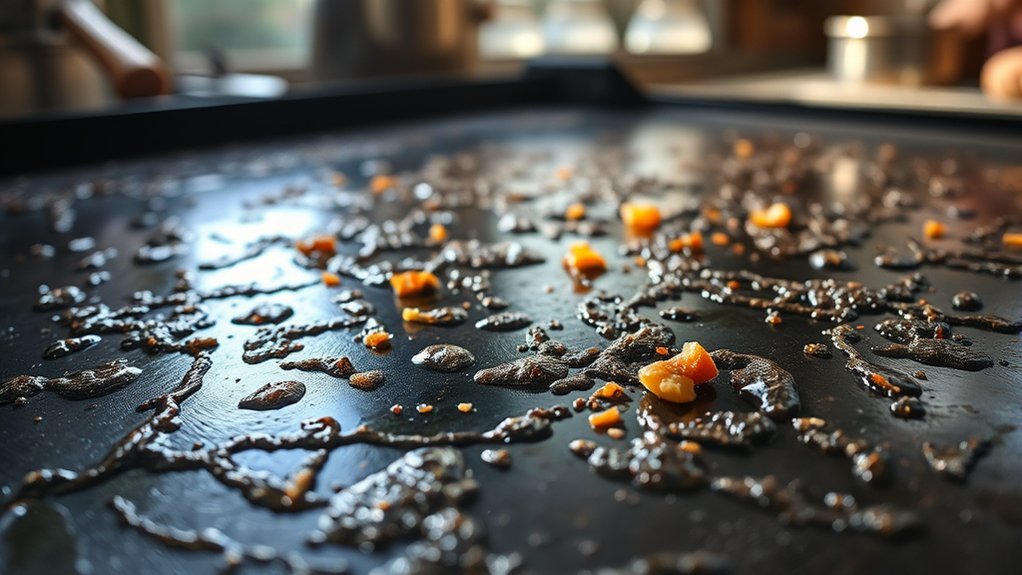

A sticky griddle can feel like walking through molasses—frustrating and slow to respond. Understanding why your griddle is sticky is key to fixing the problem and improving your cooking experience.
You might think it’s just a surface issue, but it often signals deeper problems in how you clean and season your griddle. Factors like grease buildup, improper oil choice, and uneven heating all play a role.
Understanding these can reveal why your cooking surface resists smooth performance and how to restore its exceptional condition.
Key Takeaways
- Sticky griddles often result from grease buildup and residue accumulation due to improper cleaning and maintenance.
- Incorrect seasoning, such as uneven oil application or using low smoke point oils, causes a gummy, sticky surface.
- Overheating the griddle damages the seasoning, creating a sticky polymerized film that traps food particles.
- Using abrasive cleaning tools or cleaning when the griddle is cold can damage the surface and promote stickiness.
- Repeated layers of hardened grease and residue disrupt non-stick properties, leading to increased stickiness and poor heat transfer.
Common Causes of a Sticky Griddle
Several factors can cause your griddle to become sticky, often stemming from improper cleaning, overheating, or residue buildup. When you don’t clean your griddle thoroughly, grease buildup accumulates, creating a tacky surface that traps food particles.
This residue not only affects cooking performance but also promotes further stickiness. Additionally, seasoning failure plays a significant role. If the seasoning layer intended as a protective, non-stick barrier breaks down due to overheating or incorrect application, your griddle’s surface becomes prone to food sticking.
Overheating can degrade the seasoning, causing it to polymerize improperly and leave a sticky film. Understanding these causes helps you address stickiness effectively by maintaining proper cleaning routines and seasoning techniques, ensuring your griddle remains smooth and functional.
How Grease Buildup Leads to Stickiness
You’ll notice greases accumulate in thin layers on your griddle’s surface after each use. Over time, this residue hardens, creating a sticky film that traps food particles.
This buildup disrupts the griddle’s non-stick properties and causes your food to cling.
Grease Layers Accumulate
When grease isn’t thoroughly cleaned off your griddle after each use, it gradually accumulates in thin layers that harden over time. This buildup cycle creates multiple grease layers that affect the surface’s texture, causing stickiness.
Each layer traps food particles and oils, intensifying adhesion issues and making cooking difficult.
| Grease Layer Stage | Effect on Griddle Surface |
|---|---|
| Initial Layer | Slightly oily, mild stickiness |
| Secondary Layer | Increased tackiness, food residue |
| Tertiary Layer | Hardened, uneven surface texture |
| Advanced Buildup | Significant stickiness, poor heat transfer |
Residue Hardened Over Time
How exactly does grease buildup transform from a manageable layer into a hardened residue that causes your griddle to stick? Over time, repeated cooking sessions cause grease to polymerize and carbonize under high heat, creating a dense residue buildup.
This layer becomes increasingly resistant to cleaning and disrupts the griddle’s non-stick surface. When residue buildup thickens, it leads to seasoning failure, as the protective oil layer breaks down and no longer provides a slick barrier.
The compromised seasoning allows food particles to adhere directly to the griddle, intensifying stickiness. To prevent this, you need to perform regular maintenance, including controlled heating and thorough but gentle cleaning methods, which prevent grease from hardening and preserve the seasoning’s integrity.
Why Improper Seasoning Creates a Sticky Griddle
You create a sticky surface when you apply too little oil or choose the wrong type, preventing proper polymerization. Skipping adequate heating time also leaves the seasoning incomplete, causing uneven layers that trap food residue.
To avoid this, you need precise oil selection and controlled heating to form a durable, non-stick coating.
Inadequate Oil Application
A common cause of a sticky griddle lies in inadequate oil application during seasoning. If you don’t apply enough oil, the polymerized layer won’t form uniformly, resulting in uneven surface texture and stickiness. Conversely, excess oil creates a gummy residue that traps food particles.
You need to strike a balance by applying a thin, even layer. Consider these critical factors:
- Use a two word approach: “thin coating” to ensure even coverage without excess buildup.
- Employ proper heating to allow oil to bond effectively with the metal surface.
- Avoid pooling oil in crevices, which can cause sticky patches and inconsistent seasoning.
Using Wrong Oil Type
Why does using the wrong oil type lead to a sticky griddle surface? When you apply the wrong oil, its chemical composition and smoke point may not suit high-heat seasoning. Oils with low smoke points polymerize inadequately, resulting in a partial bond with the griddle surface.
This incomplete polymerization forms a sticky residue rather than a durable, non-stick coating. Additionally, oils high in saturated fats tend to create uneven layers that trap moisture, aggravating stickiness. You must choose oils with high smoke points, like flaxseed or grapeseed oil, to ensure proper seasoning.
Using the wrong oil disrupts the curing process, leaving behind a tacky film that attracts food particles. To prevent this, always match your oil choice to the seasoning temperature and griddle material for an optimal, non-sticky finish.
Insufficient Heating Time
Selecting the proper oil is only part of achieving a well-seasoned griddle; inadequate heating time during seasoning undermines the oil’s polymerization process. When you don’t heat the griddle long enough, the oil fails to bond properly to the surface, causing sticky residue buildup.
This incomplete seasoning often leads to a burnt flavor in your food and even noise complaints from uneven heating sounds.
To avoid this, ensure you:
- Maintain consistent high heat for the recommended duration to complete polymerization
- Avoid premature cooling that disrupts the curing process
- Monitor the griddle surface for visual cues such as a smooth, matte finish
How Cooking Temperature Affects Griddle Stickiness
How does cooking temperature influence the stickiness of your griddle surface? Temperature effects directly impact the stickiness mechanisms at play. When your griddle runs too cool, oils and food proteins fail to form an adequate non-stick barrier, causing adherence.
Conversely, excessive heat can degrade the seasoning layer or cause food residues to carbonize, creating sticky buildup. Optimal temperature ensures proper polymerization of cooking fats, producing a smooth, slick surface that resists sticking.
Precise temperature control prevents incomplete Maillard reactions, which otherwise promote protein adhesion. By maintaining your griddle within recommended temperature ranges, you minimize the chemical and physical interactions responsible for stickiness.
Understanding these temperature effects allows you to adjust heat settings strategically, preserving the integrity of your griddle’s surface and ensuring effortless food release during cooking.
How Cleaning Habits Impact Your Griddle’s Surface
Maintaining optimal cooking temperature sets the foundation for a non-stick griddle surface, but your cleaning habits directly influence how well that surface holds up over time. Improper cleaning can leave residue buildup, which promotes stickiness and degrades surface integrity.
To maximize surface maintenance, you should adopt consistent, thorough cleaning practices that remove food particles without damaging the griddle.
Key cleaning habits for effective surface maintenance include:
- Cleaning the griddle while it’s still warm to dissolve grease and prevent hardened buildup
- Using non-abrasive tools and appropriate cleaners to avoid scratching or stripping the seasoning layer
- Regularly seasoning the griddle after cleaning to restore the protective coating and maintain a smooth cooking surface
Why Using the Wrong Oils Makes Your Griddle Sticky
Why does the type of oil you use affect your griddle’s stickiness? The interaction between oil chemistry and griddle materials plays a crucial role. Oils with low smoke points or high levels of polyunsaturated fats tend to polymerize improperly when heated, forming sticky residues rather than a smooth seasoning layer.
For example, vegetable oils rich in omega-6 fatty acids can break down unevenly on cast iron or steel surfaces, resulting in tacky buildup. Conversely, oils with higher saturated fat content or stable monounsaturated fats, like flaxseed or canola, create a durable, non-stick coating compatible with common griddle materials.
Choosing the wrong oil disrupts this balance, promoting uneven polymerization and a sticky surface that impedes cooking performance and complicates cleaning. Understanding oil chemistry relative to your griddle’s material is key to preventing stickiness.
When Rust and Damage Cause Griddle Problems
Improper oil selection can leave behind residues that not only cause stickiness but also create an environment where rust and physical damage are more likely to develop on your griddle’s surface. Rust compromises both the functionality and safety of your equipment, posing serious rust health risks due to contamination.
Physical damage, such as scratches or pitting, exacerbates these issues by exposing bare metal to moisture and air, accelerating oxidation.
To maintain optimal griddle performance and ensure rust prevention, focus on:
- Proper cleaning protocols to remove oil residues and debris
- Regular seasoning with appropriate oils to create a protective barrier
- Immediate repair of physical damage to prevent rust formation
Fixing a Sticky Griddle: Step-by-Step Guide
How do you effectively restore a sticky griddle to a smooth, functional surface? Begin sticky griddle troubleshooting by thoroughly cleaning the griddle with hot water and a non-abrasive scrub pad to remove residue and buildup. Avoid soap, which can strip seasoning.
Next, dry the surface completely to prevent rust. Inspect for rust spots or damage, addressing these with light sanding or scrubbing as needed. Then, apply a thin, even layer of cooking oil using seasoning best practices, preferably flaxseed or vegetable oil.
Heat the griddle gradually to polymerize the oil, creating a non-stick coating. Repeat this seasoning process two to three times for optimal results. This methodical approach ensures the griddle regains its non-stick properties and extends its functional lifespan.
Keeping Your Griddle Smooth and Non-Stick Longer
When maintaining a griddle, what practices guarantee its surface stays smooth and non-stick over time? Proper griddle maintenance is essential to prevent sticky seasoning buildup, which compromises performance. You need to control seasoning layers meticulously and clean residues promptly.
Focus on these critical actions:
- Apply thin, even seasoning layers to avoid sticky, uneven surfaces.
- Clean the griddle after each use with a scraper and mild detergent to remove food particles and oils.
- Re-season periodically using high-smoke-point oils to reinforce a durable non-stick coating.
Frequently Asked Questions
Can Using Non-Stick Spray Cause My Griddle to Become Sticky?
Yes, using oil substitutes like non-stick spray can cause your griddle to become sticky due to cleaning residue buildup. These sprays often leave behind polymers that harden when heated, requiring thorough cleaning to prevent stickiness.
Does the Type of Food I Cook Affect Griddle Stickiness?
Yes, the type of food you cook affects griddle stickiness. Foods high in sugar or protein can leave stubborn food residue, breaking down griddle seasoning.
Proper cleaning and maintenance prevent buildup and preserve the seasoning layer effectively.
How Does Humidity Impact My Griddle’s Surface?
Think of humidity as invisible moisture fogging your griddle’s surface. Its humidity impact alters cooking oil behavior, causing oils to polymerize unevenly, creating sticky residues.
You’ll notice this especially in high humidity, affecting your cooking precision.
Can Storing a Griddle Improperly Lead to Stickiness?
Yes, improper storage practices can degrade your griddle’s surface seasoning, causing stickiness. Moisture and contaminants disrupt the seasoning layer, leading to uneven cooking surfaces.
You should store it clean, dry, and lightly oiled to maintain integrity.
Is It Normal for a New Griddle to Feel Sticky Initially?
Ever wonder why your new griddle startup feels sticky? That’s typical during seasoning process narratives, as oils polymerize unevenly.
You’ll want to repeat seasoning cycles precisely to create a smooth, non-stick cooking surface over time.
Conclusion
Your griddle’s stickiness is a silent signal of underlying surface distress—grease buildup, flawed seasoning, or improper oils creating a gummy barrier that disrupts smooth cooking.
Like a well-oiled machine, your griddle needs precise cleaning, drying, and gradual re-seasoning to restore its sleek, heat-conductive surface.
By mastering these technical steps, you transform a problematic sticky griddle into a resilient, non-stick powerhouse, ensuring every meal cooks evenly and effortlessly.
Understanding why your griddle is sticky is the first step toward maintaining a perfect cooking surface.