
You might not realize that the ideal griddle temperature for pancakes isn’t just about getting them golden brown—it’s a precise range between 375°F and 400°F that balances surface browning with interior tenderness.
Setting your griddle within this window prevents undercooked centers and overly dark exteriors, but the exact heat depends on the batter’s thickness and consistency.
Understanding how to measure and adjust this temperature will change how your pancakes turn out.
Key Takeaways
- The ideal griddle temperature for pancakes is around 375°F (190°C) to balance interior cooking and exterior browning.
- Optimal cooking temperature ranges between 375°F and 400°F for uniform color and fluffy texture.
- Too high heat causes rapid browning but undercooked, dense interiors and risk of burning.
- Too low heat results in pale, rubbery pancakes with insufficient browning and longer cooking times.
- Use an infrared thermometer or water droplet test to maintain consistent griddle temperature.
What’s the Ideal Griddle Temperature for Pancakes?
How do you determine the ideal griddle temperature for pancakes? You need to balance heat to accommodate pancake thickness and batter viscosity. Thicker pancakes require a slightly lower temperature to allow the interior to cook thoroughly without burning the exterior.
Conversely, thinner pancakes can handle higher temperatures since heat penetrates faster. Batter viscosity also affects heat transfer; a more viscous batter retains heat differently, necessitating moderate griddle temperatures around 375°F (190°C) for optimal cooking.
This temperature prevents undercooked centers and excessive browning. Maintaining consistent heat ensures even cooking across pancakes, regardless of thickness or viscosity variations. Adjusting temperature finely based on these parameters leads to perfectly cooked pancakes with uniform texture and color every time you cook on your griddle.
How to Measure Your Griddle’s Heat Accurately
To get perfect pancakes, you need to measure your griddle’s heat accurately. Use an infrared thermometer for precise surface temperature readings, or perform the water droplet test to gauge heat visually.
Keep in mind that temperature can vary across the griddle, so check multiple spots before cooking.
Using An Infrared Thermometer
Why guess your griddle’s temperature when you can measure it precisely? Using an infrared thermometer allows you to accurately gauge the griddle surface temperature without contact. Simply point the device at various spots on the griddle to identify hot and cool areas.
This precision ensures the surface is at the optimal 375°F (190°C) for cooking pancake batter evenly. Maintaining this temperature prevents undercooking or burning, producing fluffy pancakes every time.
Infrared thermometers provide instant digital readings, eliminating guesswork associated with traditional methods. Regularly checking the griddle surface temperature before and during cooking helps you adjust heat settings promptly.
This tool ensures consistent results, maximizing your control over the cooking process and guaranteeing perfectly cooked pancakes with ideal texture and color.
Water Droplet Test
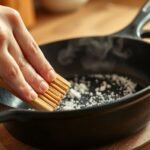
Wondering if your griddle has reached the perfect temperature for pancakes? Use the water droplet test to measure heat accurately. Sprinkle a single water drop onto the griddle surface.
If it sizzles immediately and evaporates within 1 to 2 seconds, your griddle hits the ideal pancake vibe, about 375°F (190°C). If the drop sits without much reaction, the griddle is too cool; if it skitters and evaporates instantly, it’s too hot.
This simple, reliable method helps you fine-tune temperature without specialized tools. Consistency in this test ensures your pancakes cook evenly, with a golden-brown crust and fluffy interior.
Trust the water drop’s behavior as a precise indicator of surface readiness, giving you control over your griddle’s performance every time you cook.
Surface Temperature Variations
How can you guarantee your griddle’s surface temperature is consistent across the entire cooking area? The key is precise measurement using an infrared thermometer or a surface probe. Avoid relying on unrelated topics like visual cues or irrelevant concepts such as inconsistent flame color, which don’t accurately reflect temperature variations.
Take readings at multiple points: center, edges, and corners to identify hot or cold spots. If disparities exceed 20°F, adjust your heat source or reposition the griddle. Regular calibration of your measuring tool ensures accuracy.
How to Tell When Your Griddle Is Perfectly Heated
You’ll know your griddle is perfectly heated by observing key visual indicators like a slight shimmer or faint wisps of smoke. Conduct a simple temperature test by sprinkling a few drops of water onto the surface; they should sizzle and evaporate quickly without burning.
These methods ensure you reach the ideal cooking temperature for flawless pancakes.
Visual Heating Indicators
When can you be certain that your griddle has reached the ideal temperature for pancakes? Visual heating indicators provide immediate, reliable feedback. First, observe the surface’s sheen: a slight shimmer or faint smoke signals 375°F, the optimal heat for even cooking.
Next, test with a drop of water—if it dances and evaporates quickly, the griddle is ready. Pay attention to batter consistency on the surface; it should begin to set within 20 seconds without burning or spreading excessively.
These heat indicators help you avoid under or over-heating, ensuring proper Maillard reaction and uniform browning. By mastering these visual cues, you’ll maintain consistent temperature control without relying solely on thermometers, producing perfectly cooked pancakes every time.
Temperature Test Methods
Wondering whether your griddle has reached the perfect temperature for pancakes? Accurate temperature test methods are critical since griddle material affects heat retention and distribution. You’ll want to confirm the surface is around 375°F (190°C) to optimize the pancake batter ratio’s cooking time and texture.
Try these reliable techniques to test heat:
- Flick water drops; they should sizzle and evaporate immediately without burning.
- Place a few drops of batter; it should bubble steadily without blackening.
- Use an infrared thermometer to get an exact surface reading.
- Hold your hand an inch above; you should feel strong, steady heat for 2-3 seconds.
These methods ensure your griddle’s temperature is consistent, crucial for perfectly cooked pancakes.
What Happens When Your Griddle Is Too Hot or Too Cool
How does the temperature of your griddle affect pancake quality? When your griddle is too hot, the batter sears immediately on contact, causing a burnt exterior while leaving the inside undercooked. This hot griddle condition prevents proper rise and even browning, resulting in tough, uneven pancakes.
Conversely, a cold surface fails to trigger the Maillard reaction efficiently, producing pale, dense pancakes that absorb excess oil and batter, leading to sogginess. You’ll notice slow cooking times and difficulty forming bubbles on the batter’s surface, indicators that the griddle temperature is insufficient.
Maintaining an essential temperature is vital; too hot or too cool disrupts batter chemistry and texture development, compromising taste and structure. You must avoid these extremes to achieve the ideal golden-brown pancake with a fluffy interior.
How to Adjust Griddle Heat for Different Pancake Batters
Adjusting your griddle temperature depends heavily on the type of pancake batter you’re working with. Thicker pancake batter density requires moderate heat to cook evenly without burning. Thinner batters demand slightly higher temperatures to form a proper crust quickly.
Griddle temperature adjustments hinge on batter thickness—thicker batters need moderate heat, thinner batters require higher heat for crispness.
Your griddle seasoning also influences heat distribution; a well-seasoned surface promotes even cooking and prevents sticking, allowing you to maintain consistent temperatures.
To adjust heat effectively, consider the following:
- For dense batters, lower heat to around 325°F to avoid undercooked centers.
- For thin batters, increase heat to 375°F for quick set and browning.
- If your griddle’s seasoning is fresh, reduce heat slightly to prevent sticking.
- Older seasoning layers tolerate higher heat without compromising pancake quality.
How Heat Affects Pancake Texture and Color
Why does the temperature of your griddle matter so much when cooking pancakes? It directly influences pancake texture and pancake color, determining your final product’s quality.
If the heat is too high, pancakes develop a dark, uneven color due to rapid Maillard reactions on the surface, while the interior remains undercooked and dense, negatively impacting pancake texture. Conversely, low heat results in pale pancakes with a rubbery texture because protein coagulation and starch gelatinization proceed too slowly.
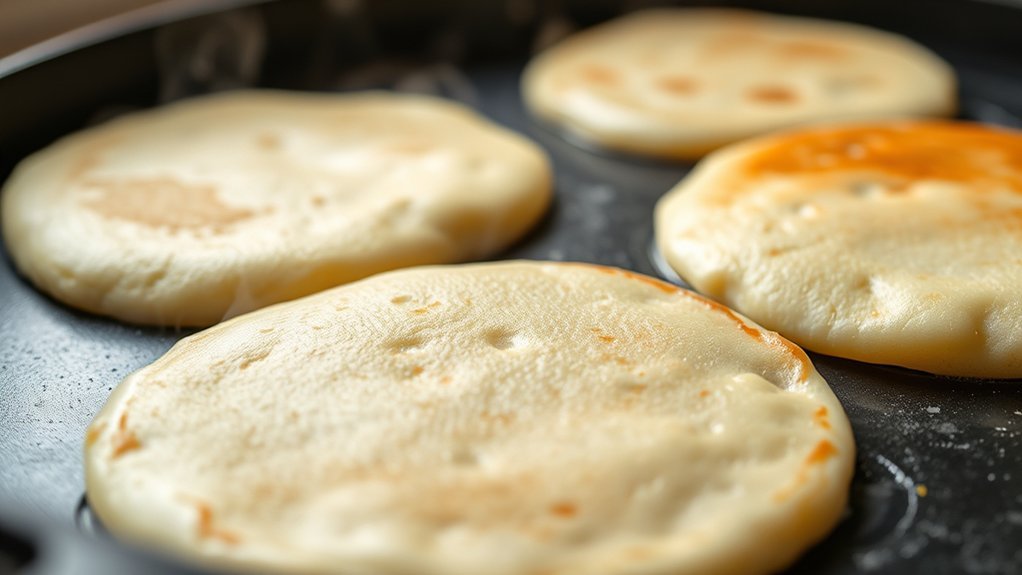
Optimal griddle temperature, typically between 375°F and 400°F, ensures balanced heat transfer, promoting uniform browning and a tender, fluffy interior. This precise control of heat allows for ideal pancake color and texture, delivering the classic golden-brown appearance and soft crumb you expect.
Tips for Adjusting Griddle Heat While Cooking Pancakes
When should you tweak your griddle’s heat during pancake cooking? Adjust the temperature when you observe inconsistent browning or delayed pancake flip timing. Proper heat management ensures even cooking and optimal texture.
Monitor the griddle spacing, as overcrowding traps steam and lowers surface temperature.
Consider these indicators for precise heat adjustments:
- Pancakes browning too fast on edges but raw inside
- Batter spreading too quickly or remaining too thick
- Delayed pancake flip timing beyond 2-3 minutes causing soggy centers
- Excessive smoke or frequent sticking despite proper greasing
Maintain moderate heat to balance Maillard reaction and internal cooking. Adjust the burner incrementally. Small changes prevent drastic texture shifts.
Consistent griddle spacing enhances airflow and temperature uniformity, crucial for flawless pancakes.
The Best Tools to Check Your Griddle’s Heat
Keeping your griddle at the right temperature requires accurate measurement tools. Proper griddle calibration ensures you cook pancakes evenly, matching the surface heat with batter temperature compatibility.
Infrared thermometers provide instant, non-contact readings, while surface probe thermometers offer precise, direct measurements. You can also use temperature-sensitive stickers for quick visual cues.
| Tool Type | Key Benefit |
|---|---|
| Infrared Thermometer | Fast, non-contact |
| Surface Probe Thermometer | Accurate direct reading |
| Temperature Stickers | Visual heat zones |
| Thermocouple Sensors | High precision |
| Griddle Calibration Kits | Ensures long-term accuracy |
Use these tools regularly to maintain consistent heat, prevent undercooked or burnt pancakes, and optimize your griddle’s performance.
Maintaining Consistent Heat When Cooking Multiple Pancakes
How do you sustain an even griddle temperature as you cook multiple pancakes simultaneously? Maintaining consistent heat is critical to avoid uneven cooking and ensure perfect texture.
Start by preheating your griddle to the optimal temperature, then adjust heat settings incrementally as pancakes cook. Monitor the batter thickness; thicker batter requires slightly lower heat to cook through without burning.
Use these techniques to manage consistent heat effectively:
- Space pancakes evenly, allowing airflow and heat distribution
- Flip pancakes only when bubbles form, avoiding premature heat loss
- Rotate pancake positions periodically to prevent hot spots
- Use a heavy, flat griddle for uniform heat retention
Frequently Asked Questions
Can I Use an Electric Griddle or Stovetop Pan for Pancakes?
You can use an electric griddle or stovetop pan for pancakes, but you must control the pan temperature precisely. Guarantee the cooking surface heats evenly to avoid burning or undercooking, maintaining consistent heat for optimal pancake texture.
What Type of Oil or Butter Is Best for Greasing the Griddle?
For pancake greasing, use clarified butter or neutral oils like canola or vegetable oil. These provide even heat distribution without burning. Avoid regular butter, which can burn quickly. This oil comparison ensures best griddle performance and taste.
How Long Does It Take to Preheat a Griddle for Pancakes?
You’ll need about 5 to 10 minutes preheat duration to reach optimal temperature, with heat recovery time minimal if you maintain consistent heat. This precision ensures even cooking and perfect pancake texture every time you flip.
Can Altitude Affect the Griddle Temperature Needed for Pancakes?
Yes, altitude effects cause temperature variability, so you’ll need to adjust your griddle’s heat slightly.
At higher altitudes, lower air pressure affects cooking, requiring you to reduce temperature to avoid burning pancakes while ensuring even cooking.
Are Non-Stick Griddles Better for Cooking Pancakes Than Cast Iron?
You’ll find nonstick advantages include easy release and quicker cleanup, while cast iron drawbacks involve uneven heating and seasoning maintenance.
For consistent pancakes, nonstick griddles offer better control and convenience in your cooking process.
Conclusion
Mastering your griddle temperature is like tuning a fine instrument—hit the sweet spot around 375°F, and your pancakes will sing with perfect browning and tender centers. Use infrared readings and the water droplet test to keep your surface consistent, adjusting for batter thickness. Avoid extremes that scorch or undercook.
With these precise controls, you’ll achieve pancake perfection every time, turning your griddle into a reliable partner in your breakfast symphony. Remember, maintaining the right temp on griddle for pancakes is key to consistent, delicious results.