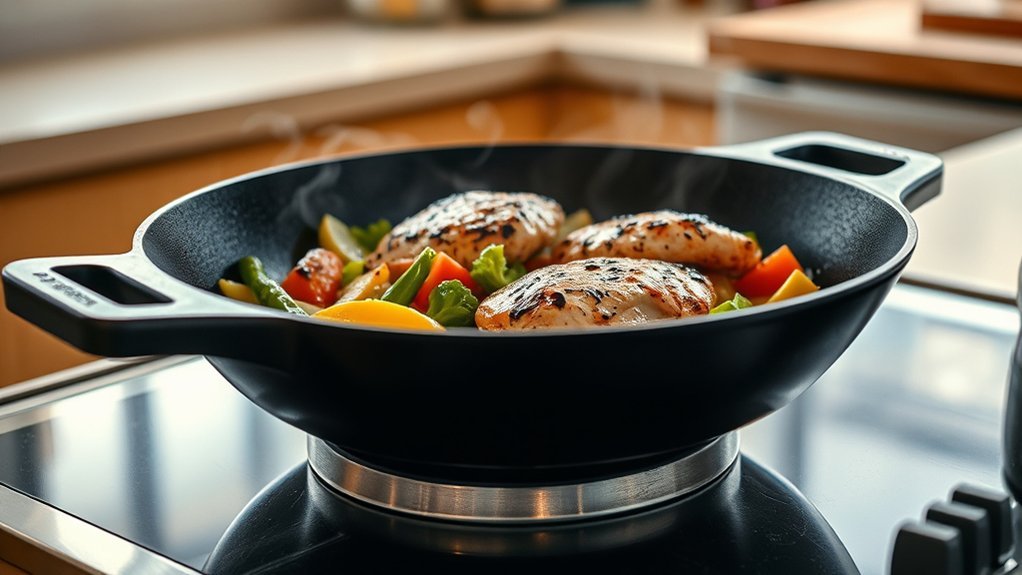

When you use a skillet, selecting the right skillet material is vital to match your cooking style and achieve the best results. You’ll want to season it properly to enhance its non-stick properties and maintain it carefully to guarantee longevity.
Heating it gradually prevents hotspots, while mastering techniques like searing and sautéing requires attention to temperature and moisture. But how do you avoid common pitfalls and extend your skillet’s life?
Key Takeaways
- Preheat the skillet gradually over medium heat to ensure even temperature and prevent hotspots before adding ingredients.
- Use a heavy-bottomed skillet like cast iron for heat retention or stainless steel for quick heating based on cooking needs.
- Pat food dry and avoid overcrowding the skillet to achieve proper searing and prevent sticking during cooking.
- After use, clean the skillet promptly with hot water and a stiff brush, dry thoroughly, and apply a thin oil layer to maintain seasoning.
- For oven use, ensure the skillet is oven-safe, preheat the oven, and handle with protective gloves when transferring.
Choosing the Right Skillet for Your Needs
How do you determine the best skillet for your cooking needs? Start by choosing materials that match your cooking style: cast iron offers exceptional heat retention and durability, while stainless steel provides quick heating and corrosion resistance.
Consider brand reputation carefully; established manufacturers often ensure consistent quality and reliable warranties. Durability plays a critical role. Select a skillet constructed with heavy-gauge metal for even heat distribution and long-term use.
Price is important but shouldn’t compromise performance. Investing slightly more in a well-crafted skillet can save you money over time due to its longevity and cooking efficiency. By balancing these factors—materials, brand reputation, durability, and price—you’ll select a skillet that delivers precise temperature control and withstands rigorous kitchen demands.
Seasoning and Maintaining Your Cast Iron Skillet
If you’ve chosen a cast iron skillet for its heat retention and durability, you’ll need to properly season and maintain it to maximize performance and lifespan. Seasoning science hinges on polymerized oils creating a non-stick, rust-resistant coating.
Avoid common maintenance myths, like scrubbing with soap or soaking in water, which degrade this layer. To maintain your skillet:
- Clean immediately after use with hot water and a stiff brush
- Dry thoroughly to prevent rust formation
- Apply a thin layer of high-smoke-point oil after drying
- Re-season periodically by heating oil-coated skillet in the oven
- Store in a dry place, avoiding stacking without protection
Following these steps preserves your skillet’s seasoning, ensuring optimal cooking results and long-term durability.
Heating Your Skillet for Best Results
When should you heat your skillet to achieve optimal cooking performance? Start heating your skillet gradually over medium heat before adding any ingredients. This controlled approach ensures uniform heating throughout the surface, which is crucial for consistent cooking.
Avoid turning the heat too high initially; rapid temperature spikes can cause hotspots, leading to uneven cooking and potential scorching. Cast iron and stainless steel skillets both benefit from this gradual warming.
To test readiness, sprinkle a few drops of water on the surface. If they sizzle and evaporate immediately, your skillet is properly heated. Proper heating not only prevents sticking but also maximizes the skillet’s thermal retention and distribution capabilities, setting a solid foundation for all your cooking tasks.
How to Sear, Sauté, and Fry in a Skillet
You’ll start by mastering searing, which requires high, consistent heat to develop a flavorful crust through the Maillard reaction.
Next, you’ll move to sautéing, where controlling the skillet’s temperature and using precise oil amounts lets you cook ingredients quickly and evenly.
Finally, frying demands maintaining the oil’s temperature to ensure a crispy texture without absorbing excess grease.
Searing Techniques Explained
How do professional chefs achieve that perfect crust and rich flavor on meats and vegetables using a skillet? The secret lies in controlling the searing temperature to trigger ideal crust formation. You’ll want to preheat your skillet until it’s smoking hot. This ensures the Maillard reaction occurs instantly, locking in juices and flavor.
Here’s how to master searing:
- Use a heavy-bottomed skillet to evenly distribute heat.
- Pat food dry to prevent steam, which inhibits crust formation.
- Apply a high searing temperature (around 400–450°F) before adding food.
- Avoid overcrowding; leave space for proper heat circulation.
- Flip only once to develop a uniform, caramelized crust.
Mastering Sauté Basics
Why does mastering sautéing elevate your skillet skills beyond simple searing? Sautéing requires controlled heat, continuous movement, and precise timing, skills that deepen your command of the skillet. Unlike searing, which focuses on a high-heat crust, sautéing involves cooking smaller pieces quickly over medium-high heat while constantly tossing or stirring.
This prevents sticking and ensures even browning without burning. Avoid topic drift by not confusing sautéing with unrelated techniques like deep frying; each demands distinct oil temperatures and methods. To sauté effectively, preheat your skillet properly, use oils with suitable smoke points, and maintain consistent movement.
Master these fundamentals, and you’ll execute sautéed dishes with optimal texture and flavor, enhancing your overall skillet proficiency.
Frying Tips and Tricks
Building on your sautéing skills, understanding the nuances of searing and frying in a skillet will expand your frying repertoire considerably. To achieve optimal results, choose the right frying equipment. A heavy-bottomed skillet retains heat better, ensuring even cooking.
Mastering oil smoke points is crucial. Use oils like avocado or grapeseed for high-heat searing to prevent burning. Control temperature precisely: too hot causes smoke and acrid flavors, too low yields soggy textures. When frying, avoid overcrowding the pan to maintain consistent heat.
- Preheat skillet thoroughly before adding oil
- Use oils with appropriate smoke points for the cooking method
- Pat proteins dry to enhance browning and prevent sticking
- Adjust heat to maintain steady sizzling without smoking
- Remove food promptly to avoid overcooking
These tips ensure professional-level searing, sautéing, and frying in your skillet.
Cooking and Baking With Your Skillet in the Oven
When should you transfer your skillet from the stovetop to the oven? You do this when your recipe requires precise, even heat that stovetop flame control alone can’t provide, like finishing a sear or baking a frittata.
Ensure your skillet is one of the oven safe pans, typically cast iron or stainless steel with heatproof handles. Avoid non-oven-safe materials that can warp or release toxins.
Preheat your oven to the specified temperature, then carefully move the skillet from the burner to the oven, using protective gloves. The skillet’s ability to maintain consistent heat makes it ideal for roasting, baking, or braising.
Preheat the oven, then transfer the skillet carefully using gloves for perfect roasting, baking, or braising.
Always consider residual heat when adjusting flame control before transfer to prevent overheating or uneven cooking. This technique expands your skillet’s versatility beyond stovetop use.
Cleaning and Storing Your Skillet Properly
To maintain your skillet’s performance, you’ll need precise cleaning techniques that preserve its seasoning without causing damage. After washing, dry it thoroughly and apply a thin layer of oil to reinforce the protective coating.
Finally, store your skillet in a dry, ventilated area to prevent rust and maintain its longevity.
Cleaning Techniques for Skillets
How exactly do you guarantee your skillet lasts through years of cooking without losing its performance? Mastering effective cleaning techniques is essential. Start by avoiding harsh detergents that strip seasoning. Instead, use warm water and a stiff brush to clean residues.
For stubborn stuck-on food, sprinkle coarse salt and scrub gently. Address rust removal immediately by applying a paste of baking soda and water, scrubbing with a non-metallic pad. Follow these precise steps:
- Rinse skillet promptly after use to prevent residue buildup
- Avoid soaking to protect seasoning layers
- Use non-abrasive tools to maintain surface integrity
- Apply rust removal treatments at first sign of corrosion
- Thoroughly rinse and dry before storage to inhibit rust formation
These techniques preserve your skillet’s seasoning and structural integrity for long-term use.
Drying and Seasoning Tips
Proper drying and seasoning directly impact your skillet’s longevity and cooking performance after cleaning. For drying tips, immediately towel-dry your skillet to remove surface moisture, then place it on low heat for several minutes to ensure complete evaporation. This prevents rust formation, a common issue with cast iron.
Regarding seasoning tips, apply a thin, even layer of high-smoke-point oil like flaxseed or grapeseed while the skillet is warm. Use a lint-free cloth to spread the oil and wipe away excess to avoid sticky buildup. Then, heat the skillet upside down in the oven at 450°F for an hour, allowing polymerization to create a durable, non-stick layer.
Repeat this process periodically to maintain optimal seasoning and protect your skillet from corrosion and food sticking.
Proper Skillet Storage Methods
Where you store your skillet can markedly affect its condition and lifespan. To maintain its seasoning and prevent rust, you need optimal storage solutions focused on space optimization and protection.
First, ensure your skillet is completely dry and lightly oiled before storage. Then, consider these storage techniques:
- Use a dedicated hook or rack to hang your skillet, preventing surface scratches.
- Store with a paper towel or cloth inside to absorb moisture.
- Avoid stacking with other cookware unless separated by a protective layer.
- Opt for cabinet organizers designed for heavy cast iron to maximize space.
- Keep it in a well-ventilated area to minimize humidity exposure.
Implementing these methods preserves your skillet’s integrity and guarantees consistent performance over time.
Troubleshooting Common Skillet Cooking Problems
Why does your skillet cooking sometimes yield uneven results or cause food to stick? Uneven heat distribution is often the culprit, especially if your skillet’s base warps or the burner size doesn’t match the pan. This causes hot spots, leading to inconsistent cooking.
Skillet rust can also interfere by creating rough patches that cause sticking and affect heat conduction. To troubleshoot, always preheat your skillet gradually to stabilize temperature. Check for rust regularly; if present, scrub it off and re-season the pan to restore its non-stick surface.
Additionally, ensure your heat source matches your skillet size to promote even heat flow. Using the right oil at proper temperatures further minimizes sticking. Proper maintenance and mindful heating will solve most common skillet cooking issues.
Frequently Asked Questions
Can I Use a Skillet on an Induction Cooktop?
You can use a skillet on an induction cooktop if it has induction compatibility, usually a magnetic base. This ensures efficient heat distribution and energy transfer, giving you precise temperature control and optimal cooking performance.
Are Non-Stick Skillets Safe for High-Heat Cooking?
Think of your nonstick coating as a delicate shield; it’s not built for high heat safety.
Exposing it above 500°F risks breakdown, releasing toxins and degrading performance, so you shouldn’t use non-stick skillets for intense high-heat cooking.
How Do I Prevent Food From Sticking to a Stainless Steel Skillet?
To master sticking prevention, preheat your stainless steel skillet until shimmering, then add oil and wait for it to heat thoroughly. This two-word discussion idea guarantees a natural non-stick surface, minimizing food adhesion during cooking.
Is It Okay to Put a Hot Skillet Directly Into Cold Water?
Don’t dunk your scorching skillet into cold water unless you want a kitchen disaster! Hot water safety is essential. Rapid cooling methods can cause warp or cracks.
Instead, let it cool gradually to maintain your skillet’s integrity and performance.
Can I Use Metal Utensils on a Cast Iron Skillet?
You can use metal utensils on a cast iron skillet without damaging it, but be cautious. Using metal utensils is safe if you maintain your seasoning properly and avoid excessive scraping during high heat care to preserve the skillet’s surface.
Conclusion
Mastering your skillet transforms cooking into a culinary adventure, unleashing flavors so bold they could wake the dead. Choose the right material, season it well, and heat gradually to avoid hotspots.
Pat your ingredients dry for perfect searing, sauté with steady motion, and fry at ideal oil temperatures. Finish dishes in the oven when needed.
Clean, dry, oil lightly, and store properly to keep your skillet performing like a precision instrument for years to come. With proper care and technique, your skillet will become an indispensable tool in your kitchen.