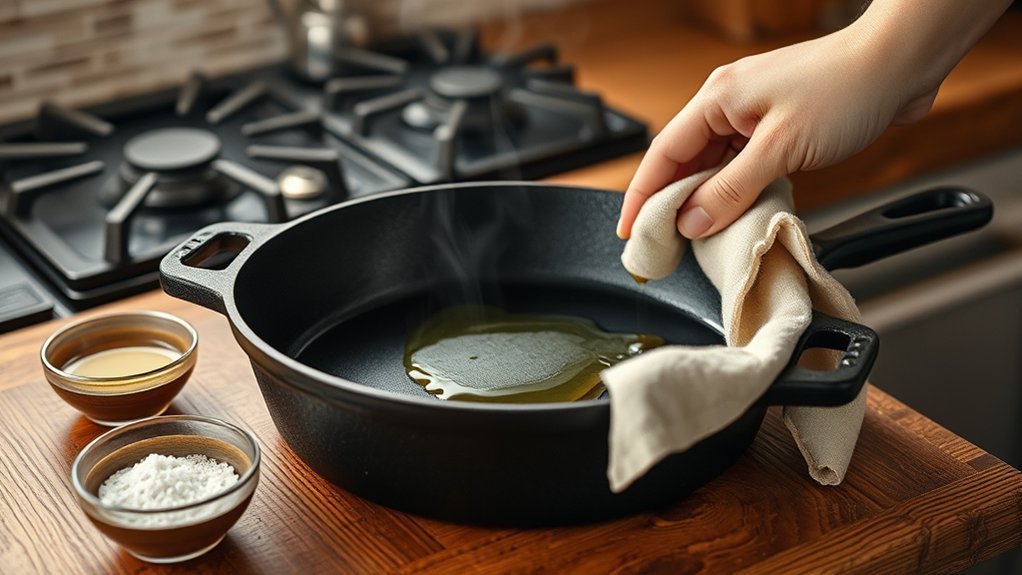

When you get a new cast iron skillet, seasoning a new cast iron skillet properly is essential to release its full potential. This process creates a durable, non-stick surface that protects against rust and improves cooking performance.
Skipping or rushing seasoning can lead to uneven coating and sticky spots. To guarantee your skillet performs well and lasts for years, you need to understand the right cleaning steps, oil choices, and baking techniques before you start.
Key Takeaways
- Thoroughly clean the skillet with hot water and a stiff brush to remove factory residue, then dry completely using stove heat.
- Apply a thin, even layer of high-smoke-point oil, such as flaxseed or grapeseed oil, over the entire skillet surface.
- Preheat your oven to 450°F (232°C) and bake the skillet upside down on the middle rack for one hour to polymerize the oil.
- Let the skillet cool inside the oven after baking to complete the curing process and form a durable, non-stick coating.
- Repeat the oil application and baking process 3 to 5 times for optimal seasoning and to enhance durability and cooking performance.
What Is Seasoning a Cast Iron Skillet?
Seasoning a cast iron skillet involves applying a thin layer of oil and heating it to create a durable, non-stick coating. This process relies on polymerization, where oil molecules bond to the skillet’s surface under heat.
You’ll want to understand seasoning terminology like “polymerization” and “curing” to grasp how the layer forms. Selecting an oil with an appropriate smoke point is essential; oils with higher smoke points, such as flaxseed or grapeseed oil, withstand the heating process without burning.
Heating beyond the oil’s smoke point triggers chemical changes that solidify the layer, enhancing durability and resistance. By controlling oil type and temperature, you guarantee a professional-quality seasoning layer that improves cooking performance and longevity.
Why Is Seasoning a New Cast Iron Skillet Important?
Why does a new cast iron skillet demand proper treatment before its first use? Seasoning is essential because it creates a durable, non-stick surface and protects the skillet from rust and corrosion. Without seasoning, the iron remains porous and vulnerable to moisture, which compromises performance and longevity.
Proper seasoning forms a polymerized oil layer that bonds to the skillet’s surface, enhancing heat distribution and cooking efficiency. This two word discussion ideas “surface protection” highlight the subtopic relevance to both durability and cooking quality.
Skipping this step results in food sticking and uneven heating, undermining the skillet’s potential. By understanding why seasoning matters, you ensure your cast iron skillet performs optimally and lasts for generations. This foundational knowledge sets the stage for mastering subsequent seasoning steps.
Essential Supplies for Seasoning Your Cast Iron Skillet
To season your cast iron skillet effectively, you need to select the right oil with a high smoke point, such as flaxseed or grapeseed oil.
You’ll also require essential cleaning tools, including a stiff brush and non-abrasive scrubber, to prepare the skillet’s surface properly. Having these supplies ready guarantees a durable, even seasoning layer.
Choosing The Right Oil
How do you select the best oil for your cast iron skillet’s seasoning process? Understanding seasoning science is key. You want an oil with a high smoke point and a molecular structure that polymerizes well under heat, forming a durable, non-stick layer.
Flaxseed oil is often recommended due to its high concentration of polyunsaturated fats, which cure into a hard, resilient coating. However, other oil alternatives like grapeseed, canola, or vegetable oil also work effectively if they have smoke points above 400°F.
Avoid oils prone to rancidity or low smoke points, as they can result in sticky or uneven layers. By choosing the right oil, you ensure optimal seasoning durability and performance, setting a strong foundation for your cast iron skillet’s longevity and cooking efficiency.
Necessary Cleaning Tools
What tools do you need to prepare your cast iron skillet for seasoning? Essential cleaning tools ensure a pristine surface, critical for an even, durable seasoning layer. You’ll need a sturdy scrub brush, non-abrasive sponge, and lint-free cloth to remove residues without damaging the skillet’s surface.
| Tool Type | Purpose | Recommendation |
|---|---|---|
| Scrub Brush | Remove stuck particles | Nylon bristles preferred |
| Non-abrasive Sponge | Gentle cleaning | Cellulose or silicone |
| Lint-free Cloth | Dry and polish | Microfiber ideal |
Using these tools with the two word idea1 “cleaning method” and two word idea2 “surface prep” guarantees optimal seasoning adherence. Avoid harsh detergents; instead, rely on warm water and mechanical cleaning to maintain your skillet’s integrity.
How to Clean Your Cast Iron Skillet Before Seasoning
Before you start seasoning, you need to remove any factory residue by scrubbing the skillet with hot water and a stiff brush. Avoid soap to preserve the iron. After rinsing thoroughly, dry the skillet completely using a lint-free cloth and heat it on the stove to evaporate any remaining moisture.
Proper cleaning and drying are critical to ensure the seasoning bonds correctly to the cast iron surface.
Removing Factory Residue
Why is it essential to remove factory residue from your new cast iron skillet before seasoning? Factory residue, including protective oils and coating residue, can prevent proper bonding of seasoning layers. Without thorough removal, the seasoning won’t adhere correctly, compromising durability and performance.
For effective removal factory residue, follow these steps:
- Scrub the skillet with hot water and mild dish soap to break down surface oils.
- Use a stiff brush or non-metallic scrubber to remove coating residue without damaging the iron.
- Rinse thoroughly to eliminate all soap and residue traces.
- Dry immediately to avoid rust formation (covered in the next section).
Proper removal factory residue ensures a clean surface, essential for optimal seasoning adhesion and long-term skillet integrity.
Thorough Drying Techniques
How do you guarantee your cast iron skillet is completely dry after cleaning to prevent rust and promote effective seasoning? Thorough drying techniques are critical for ensuring the skillet’s surface is moisture-free, preventing oxidation, and ready for optimal seasoning application.
Begin by towel drying immediately after washing to remove excess water. Then, apply heat on your stovetop or in an oven to evaporate residual moisture fully. This method fortifies your skillet against rust and enhances the bonding of seasoning layers.
| Step | Action |
|---|---|
| Initial Drying | Wipe skillet with a clean towel |
| Heat Application | Warm skillet on stovetop |
| Final Check | Inspect for visible moisture |
Employ these precise steps to maintain your cast iron’s integrity before seasoning.
Best Oils for Seasoning Your Cast Iron Skillet
Choose oils with a high smoke point and a stable chemical structure to guarantee effective seasoning of your cast iron skillet. Avoid common seasoning myths that suggest any cooking oil will suffice. Understanding oil smoke points is crucial. Oils that polymerize well form a durable, non-stick layer.
Top oils for seasoning include:
- Flaxseed oil: high smoke point, polymerizes into a hard, durable coating
- Grapeseed oil: stable, neutral flavor, smoke point around 420°F
- Canola oil: widely available, smoke point near 400°F, good polymerization
- Avocado oil: very high smoke point (~520°F), excellent for seasoning
Selecting the right oil ensures consistent seasoning quality and longevity. It prevents sticky or uneven layers caused by oils with low smoke points or unstable bonds.
Step-by-Step: Seasoning Your New Cast Iron Skillet
Now that you’ve selected the ideal oil for seasoning, it’s time to prepare your new cast iron skillet properly. Begin by washing the skillet with warm water and mild soap to remove factory residues; dry it completely.
Start by washing your new cast iron skillet with warm water and mild soap, then dry thoroughly.
Next, apply a thin, even layer of your chosen oil across all surfaces, including the handle and exterior. Use a lint-free cloth or paper towel to ensure no excess oil remains, preventing sticky buildup.
Preheat your oven to 450°F (232°C), then place the skillet upside down on the middle rack with a foil-lined tray below to catch drips. Bake for one hour, allowing the oil to polymerize and bond to the cast iron.
After baking, turn off the oven and let the skillet cool inside to complete the seasoning process on your new skillet.
How Many Seasoning Coats Should You Apply?
Determining the essential number of seasoning coats is pivotal for building a durable, non-stick surface on your cast iron skillet. Generally, applying 3 to 5 thin coats of oil guarantees a robust polymerized layer that withstands use. Each coat should be baked at high temperature to bond effectively.
Consider these factors when deciding how many coats to apply:
- Initial seasoning quality: more coats for a raw skillet
- Intended use: frequent use on cornless stovetops may require extra durability
- Cleaning tools: metal spatulas demand a tougher surface to prevent damage
- Visual and tactile cues: a smooth, semi-gloss finish indicates sufficient seasoning
Applying too few coats compromises performance, while excessive layers may flake. Stick to this range for superior resilience and non-stick properties.
How to Maintain Your Cast Iron Skillet’s Seasoning After Cooking
How often you clean and care for your cast iron skillet after cooking directly impacts the longevity of its seasoning. Proper maintenance relies on understanding seasoning science and oil chemistry to preserve the polymerized oil layer that prevents rust and ensures non-stick performance.
Avoid harsh detergents; instead, use hot water and a stiff brush. Dry immediately to prevent oxidation, then apply a thin oil coat to replenish the seasoning.
| Action | Purpose | Recommended Frequency |
|---|---|---|
| Gentle cleaning | Remove food residue without stripping seasoning | After each use |
| Thorough drying | Prevent rust formation | Immediately after washing |
| Oil application | Restore protective polymerized layer | Every use or as needed |
Consistent care sustains the skillet’s integrity, optimizing seasoning durability and cooking performance.
Common Seasoning Mistakes to Avoid
Although seasoning a cast iron skillet may seem straightforward, certain common mistakes can undermine its effectiveness and durability. Avoid these pitfalls to ensure a robust, long-lasting seasoning layer.
Applying excessive oil can cause sticky residue rather than a smooth finish. Use a thin, even coat.
Skipping the heating phase prevents proper polymerization of the oil, weakening the seasoning.
Using inappropriate oils with low smoke points leads to uneven seasoning and flaking.
Neglecting thorough cleaning between seasoning sessions traps food particles, impeding seasoning adherence.
Stay focused on two word discussion ideas relevant to seasoning; avoid nonrelevant topics that distract from the technical process. By steering clear of these mistakes, you’ll maintain an optimal, durable seasoning that enhances your skillet’s performance and longevity.
How to Re-Season or Fix Rust and Sticky Spots on Your Skillet
If you notice rust or sticky spots on your cast iron skillet, start by removing rust with a fine steel wool or abrasive pad until the surface is smooth.
Next, eliminate any sticky residue by thoroughly cleaning with hot water and mild detergent, then drying completely. Finally, apply a thin layer of oil and bake the skillet at high heat to restore a durable, non-stick seasoning layer.
Removing Rust Effectively
Why does rust appear on your cast iron skillet, and what’s the best way to eliminate it? Rust forms when moisture contacts unprotected iron. For effective rust removal, follow these steps:
- Scrub the skillet with steel wool or a stiff brush to remove surface rust.
- Rinse thoroughly and dry immediately to prevent further oxidation.
- Apply a thin layer of vegetable oil or flaxseed oil to the skillet’s surface.
- Heat the skillet in an oven at 450°F (232°C) for one hour to polymerize the oil, creating a protective seasoning layer.
Consistent rust prevention relies on thorough drying and regular seasoning after each use. This process restores the skillet’s protective coating, ensuring durability and optimal cooking performance.
Tackling Sticky Residue
How do you effectively remove sticky residue or fix rust and sticky spots on your cast iron skillet? Start by scrubbing the affected areas with a non-abrasive brush and coarse salt to lift residue without damaging the seasoning. Rinse thoroughly and dry immediately to prevent rust.
If sticky residue persists, apply a thin layer of oil and heat the skillet to polymerize a fresh protective coating.
| Issue | Cause | Quick Fix |
|---|---|---|
| Sticky residue | Excess oil or improper heat | Scrub with salt, reapply oil |
| Rust spots | Moisture exposure | Remove rust, dry, oil, heat |
| Patchy seasoning | Uneven oil application | Use seasoning tricks like thin, even coats |
These seasoning tricks maintain your skillet’s non-stick surface and longevity.
Proper Re-Seasoning Steps
Although restoring your cast iron skillet may seem formidable, following a systematic re-seasoning process will effectively repair rust and sticky spots while reinforcing its protective coating. Start by scrubbing the affected areas with steel wool and mild soap. Dishwasher safety doesn’t apply here, as dishwashers strip seasoning.
Rinse thoroughly and dry completely to prevent further rust. Next, apply a thin, even layer of high-smoke-point oil. Preheat your oven to 450°F (232°C), ensuring induction compatibility if using an induction cooktop.
Place the skillet upside down with foil beneath to catch drips. Bake for one hour, then cool gradually. Repeat as needed for durability. This method restores your skillet’s non-stick surface and prevents rust, maintaining optimal cooking performance and longevity.
Frequently Asked Questions
Can I Season a Cast Iron Skillet in a Microwave?
You can’t season a cast iron skillet in a microwave due to uneven heating and microwave risks. Proper seasoning methods require consistent, high-temperature oven baking to polymerize oil, creating a durable, non-stick surface.
Avoid microwave attempts.
How Long Does a Seasoned Skillet Last Without Re-Seasoning?
A seasoned skillet’s seasoning longevity typically lasts months with proper use, but you should assess its non-stick surface regularly. Establish a maintenance cadence by re-seasoning whenever you notice dullness, rust, or food sticking to guarantee optimal performance.
Is It Safe to Use Soap on a Cast Iron Skillet?
Yes, using mild soap occasionally is safe for cast iron cleaning; it won’t strip the seasoning if you rinse thoroughly and dry immediately. Avoid harsh detergents to maintain soap safety and preserve your skillet’s seasoned surface.
Can I Use Vegetable Shortening Instead of Oil for Seasoning?
Yes, you can use vegetable shortening as a seasoning oil for cast iron care. It polymerizes well, creating a durable non-stick layer.
Ensure even application and proper heating to achieve optimal seasoning results and longevity.
Does Seasoning Affect the Skillet’s Cooking Temperature?
Seasoning effects don’t substantially alter your skillet’s cooking temperature. Instead, seasoning creates a non-stick layer that improves heat distribution and retention, ensuring more even cooking without changing the actual temperature at which your skillet operates.
Conclusion
Seasoning your cast iron skillet isn’t just a chore—it’s the secret sauce to unlocking its full potential. By carefully applying multiple thin coats of high-smoke-point oil and baking it properly, you build a resilient, non-stick surface that’ll last for years.
Remember, slow and steady wins the race; rushing the process can lead to uneven seasoning or sticky spots. Keep up with maintenance, and your skillet will serve you like a trusted workhorse in the kitchen.
In the end, proper seasoning is key to getting the best performance from your new cast iron skillet.