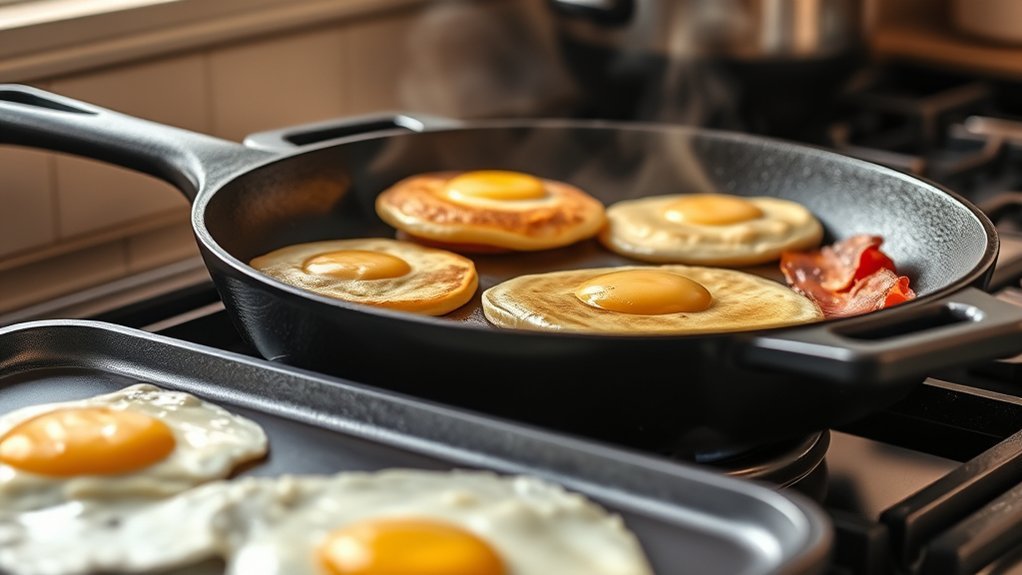

You might think a frying pan and a griddle are interchangeable, but can you use a frying pan instead of a griddle? Their differences can affect your cooking more than you expect. While a frying pan can stand in for a griddle, it requires some adjustments to get the best results.
Understanding how heat distributes and how surface area impacts your food can change the way you cook. Let’s explore what you need to know before making the swap.
Key Takeaways
- Frying pans can substitute griddles but may cook unevenly due to sloped sides concentrating heat at the center.
- Use a flat-bottomed frying pan and preheat thoroughly to mimic a griddle’s even heat distribution.
- Lower heat slightly and avoid overcrowding to prevent burning and ensure more consistent cooking.
- Frying pans are smaller, limiting batch size and multitasking compared to the expansive griddle surface.
- Non-stick or cast iron pans improve frying pan performance for griddle-style cooking with easier cleanup and better heat retention.
What’s the Difference Between a Frying Pan and a Griddle?
Although both frying pans and griddles help you cook a variety of foods, they serve distinct purposes in the kitchen. The key difference lies in their design and cooking efficiency.
A frying pan has sloped sides, which limit the surface contact with your food, causing uneven heat distribution. In contrast, a griddle offers a flat, expansive surface, maximizing surface contact and providing a more consistent difference in heat across its area.
This means you can cook multiple items evenly at once on a griddle, while a frying pan concentrates heat in a smaller spot. Understanding this difference in heat and surface contact helps you choose the right tool for your cooking needs, whether you’re searing, frying, or making breakfast staples.
Can a Frying Pan Replace a Griddle?
You might wonder if a frying pan can stand in for a griddle when cooking your favorite meals. Consider how heat spreads differently across each surface, along with the size and shape that affect what you can cook at once.
Understanding these factors helps you decide which tool fits your cooking style best.
Heat Distribution Differences
How evenly does heat spread when you swap a frying pan for a griddle? When you rely on a frying pan, heat mapping reveals more concentrated warmth at the center, often leaving edges cooler. This uneven heat can affect cooking consistency, making you adjust food placement frequently.
In contrast, griddles are designed for broad, uniform heat distribution, which helps maintain steady temperatures across the entire surface. This even heating plays a crucial role in moisture evaporation. With a frying pan, hotspots can cause uneven moisture loss, potentially drying some parts of your food while undercooking others.
Understanding these heat distribution differences helps you decide if a frying pan can meet your cooking needs or if a griddle’s more balanced heat is worth the investment.
Surface Area Considerations
When considering whether a frying pan can replace a griddle, surface area plays a pivotal role in your cooking experience. A griddle’s expansive flat surface lets you cook multiple items simultaneously, while a frying pan’s smaller, curved surface limits how much food you can prepare at once.
This difference often leads to a techniques mismatch; for example, flipping several pancakes side by side on a frying pan becomes tricky. Also, material compatibility affects heat spread. Griddles typically feature materials optimized for even heating across a wide area, unlike many frying pans designed for focused heat.
Cooking Versatility Comparison
Although both frying pans and griddles serve essential roles in the kitchen, their cooking versatility varies considerably. You’ll find that griddles excel in managing even cooking speeds and preserving distinct flavor profiles across multiple ingredients.
Frying pans, meanwhile, offer more control for sautéing and searing but can struggle with larger batches.
| Feature | Frying Pan |
|---|---|
| Cooking Speeds | Faster for single items |
| Flavor Profiles | Intense, focused flavors |
| Batch Size | Limited, smaller quantities |
| Feature | Griddle |
| Cooking Speeds | Consistent, moderate speed |
| Flavor Profiles | Balanced, melded flavors |
| Batch Size | Larger, ideal for groups |
How Heat Spreads Differently in Frying Pans and Griddles
When you heat a frying pan, the heat concentrates mostly at the center, creating hot spots that can cook food unevenly. In contrast, a griddle offers a larger, flatter surface that spreads heat more uniformly, giving you consistent cooking across the entire area.
Understanding these differences helps you choose the right tool for your cooking style and the dishes you want to make.
Heat Distribution Patterns
Because frying pans and griddles have different shapes and materials, they distribute heat in unique ways that affect your cooking experience. Frying pans, often curved with thicker bases, concentrate heat toward the center, creating a hot spot ideal for searing. Their countertop design usually supports even heating but can vary depending on material and thickness.
Griddles, with their flat, expansive surfaces, spread heat more evenly across a wider area, perfect for cooking multiple items simultaneously. Nonstick coatings on both pans influence heat conduction, but griddles often feature sturdier coatings to handle larger surface areas.
Understanding these heat distribution patterns helps you adjust cooking times and temperatures, ensuring your food cooks evenly whether you choose a frying pan or a griddle.
Surface Contact Differences
The way your food touches the cooking surface plays a big role in how heat transfers and cooks your meal. Frying pans, with their curved edges, offer less flat surface area, concentrating heat in the center.
Griddles, however, provide expansive, flat surfaces ensuring even heat distribution across your food. This difference affects cooking consistency and browning.
| Feature | Frying Pan | Griddle |
|---|---|---|
| Surface Area | Smaller, curved | Larger, flat |
| Heat Distribution | Concentrated, uneven | Even, consistent |
| Contact with Food | Partial, due to shape | Full, maximizes contact |
Understanding these surface contact differences helps you choose the right tool for uniform cooking or high-heat searing.
How to Adjust Cooking Times and Temperatures With a Frying Pan
How do you guarantee your food cooks evenly and perfectly when swapping a griddle for a frying pan? First, lower your heat slightly since frying pans concentrate heat more than griddles, preventing burning.
Adjust cooking times by checking food frequently. Frying pans may cook faster due to their curved sides and smaller surface, so stay attentive. For low fat cooking, use a non-stick frying pan and minimal oil; this helps you maintain healthy meals without compromising texture.
Also, consider kitchen ergonomics: frying pans are lighter and easier to maneuver, letting you flip or stir food effortlessly, which aids even cooking. By managing temperature and timing carefully, you’ll enjoy perfectly cooked dishes, even without a griddle’s expansive surface.
Why Surface Area Matters When Choosing Between These Tools
Why does surface area play such an essential role when deciding between a frying pan and a griddle? It’s all about how much space you have to spread your food.
A griddle offers a larger, flat surface ideal for cooking multiple items at once, while a frying pan’s smaller area limits your batch size. Think of it like popcorn science: more space means better heat distribution and less crowding, which prevents steaming and promotes even browning.
Cookware ergonomics also come into play. Griddles often have handles on both sides, making them easier to maneuver when fully loaded. When you choose between these tools, consider how surface area affects cooking efficiency, heat control, and your comfort in handling the cookware during meal prep.
Cooking Tasks Better on a Griddle Than a Frying Pan
When you need even heat across a wide surface, a griddle outperforms a frying pan every time. Its larger cooking area lets you prepare multiple items at once without crowding. This makes it perfect for tasks like cooking pancakes, bacon, or grilled sandwiches with consistent results.
Even Heat Distribution
Where does heat spread more evenly: a griddle or a frying pan? A griddle excels thanks to its flat, expansive surface that promotes consistent heat transfer across the entire cooking area.
Unlike frying pans, which often have curved edges and varying thicknesses, griddles maintain uniform temperature, reducing hot spots that can burn your food. When you use a griddle, the cookware ergonomics also play a role. The flat design lets you maneuver spatulas smoothly and flip multiple items at once without crowding.
In contrast, frying pans focus heat in the center, causing uneven cooking, especially on the sides. So, if even heat distribution matters for your cooking tasks, the griddle’s design offers superior control and reliability, making your meals turn out more evenly cooked every time.
Larger Cooking Surface
How much cooking space do you really need? When you’re preparing breakfast for a crowd or cooking multiple items at once, a griddle’s larger cooking surface becomes a game-changer. Unlike a frying pan, which limits how much you can cook at once, a griddle offers ample room to spread out your ingredients without overcrowding.
This means better browning and even cooking. Plus, griddles often boast superior pan durability, designed to withstand high heat and frequent use. They also handle higher oil smoke points better, allowing you to cook with oils that tolerate heat without burning.
Tips for Using a Frying Pan Like a Griddle
Wondering how to get the most out of your frying pan when you don’t have a griddle on hand? First, make sure your pan has a flat top to mimic the griddle’s even surface. Preheat your pan thoroughly until it’s a hot pan, which helps achieve consistent cooking and those perfect sear marks.
Avoid overcrowding; give each item enough space so heat distributes evenly. Use a spatula to gently press down foods like pancakes or sandwiches to ensure full contact with the pan’s surface.
Keep the temperature moderate to prevent burning but high enough to maintain a steady sizzle. With these tips, your frying pan can deliver griddle-like results, making it a versatile tool for your kitchen adventures.
Best Frying Pans for Griddle-Style Cooking
Which frying pan will give you the best results when aiming for griddle-style cooking? You’ll want to focus on pans with a wide, flat surface and even heat distribution. Cast iron frying pans excel here. They retain heat well and create that perfect sear.
Nonstick pans also work if you prefer easier cleanup and less oil. When choosing, consider your user preferences: do you value weight and durability, or quick heating and convenience? Following tactical guidelines, opt for a pan at least 10-12 inches in diameter to provide ample cooking space.
Flat-bottomed pans without deep sides mimic a griddle’s surface best, giving you room to flip pancakes or cook multiple items simultaneously. Selecting the right pan transforms your kitchen experience, making griddle-style meals effortless.
How to Clean and Care for Frying Pans and Griddles
Keeping your frying pans and griddles in top shape starts with proper cleaning and care routines that suit their materials. Whether you have cast iron, stainless steel, or non-stick surfaces, following specific care tips prevents damage and extends their life.
For instance, avoid soaking cast iron; instead, wipe it clean and re-season regularly. Don’t fall for common care myths like scrubbing non-stick pans with harsh abrasives—it only ruins the coating. Instead, use gentle sponges and mild detergents.
For griddles, clean off residue promptly and oil the surface to maintain seasoning. By understanding these nuances, you’ll keep both your frying pans and griddles performing at their best, saving money and improving your cooking experience with every meal.
When It’s Worth Investing in a Griddle Instead of a Frying Pan
Proper maintenance guarantees your cookware performs well, but choosing the right tool for the job can make an even bigger difference. When you cook breakfast for a crowd or want perfectly even heat for pancakes and bacon, a griddle beats a frying pan every time. Don’t get distracted by irrelevant topics or stray comparisons between pans; they don’t capture the griddle’s true advantages.
| Feature | Griddle Benefit |
|---|---|
| Cooking Surface | Large, flat for multiple items |
| Heat Distribution | Even, reduces hotspots |
| Capacity | Cook more food at once |
| Ease of Flipping | Spacious space for easy turning |
| Cleaning | Simple, fewer corners to scrub |
Invest in a griddle when you value efficiency and uniform cooking over the limited versatility of frying pans.
Frequently Asked Questions
Can You Use a Griddle Outdoors on a Camping Stove?
You can definitely use a griddle camping on an outdoor stove. Just make sure your griddle fits securely, distributes heat evenly, and is stable.
It’s perfect for cooking multiple items quickly while enjoying the outdoors.
Are Electric Griddles Healthier for Cooking Than Frying Pans?
You’ll find electric griddles offer healthier cooking than frying pans since they use less oil and provide even heat.
Comparing electric griddle vs frying pan, griddles help reduce fat, making your meals lighter and tastier.
What Materials Are Best for Non-Stick Frying Pans?
You’ll want nonstick pans made from ceramic or hard-anodized aluminum for excellent durability and material safety. These materials resist scratching and release food easily, so you’ll cook healthier meals without worrying about harmful coatings degrading.
Can a Cast Iron Griddle Be Used on Induction Cooktops?
You might wonder if your cast iron griddle will work on induction cooktops. Good news! It’s perfect due to cast iron compatibility.
Induction friendly cookware relies on magnetic materials, and cast iron fits the bill brilliantly.
How Do You Prevent Food From Sticking on a Griddle?
To prevent food from sticking on your griddle, season it well by applying oil and heating evenly. Avoid hot spots by preheating gradually, ensuring consistent heat distribution for perfect, non-stick cooking every time.
Conclusion
You can definitely use a frying pan instead of a griddle, but keep in mind that 65% of home cooks say their griddles cook more evenly due to a larger surface area.
To get the best results, preheat your pan thoroughly, avoid overcrowding, and press food for full contact. These steps help ensure your food cooks evenly and develops a great sear.
With the right technique, your frying pan can deliver nearly griddle-like results—just adjust your heat and timing, and you’ll be flipping like a pro in no time!
In conclusion, while a frying pan works well, mastering how to use a frying pan instead of a griddle will help you achieve the best cooking outcomes.