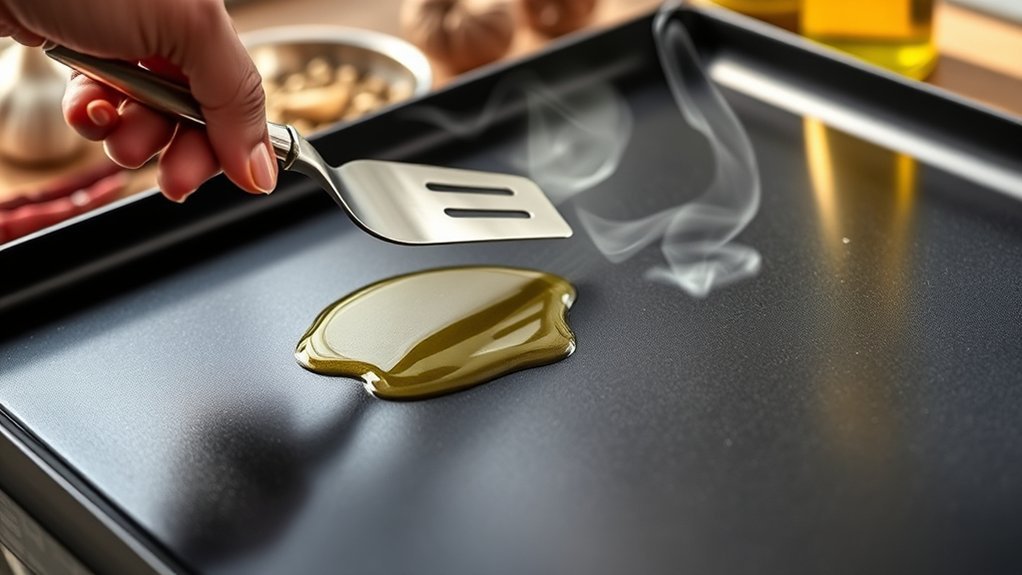

Seasoning your 17-inch Blackstone griddle is essential for creating a durable, high-performance cooking surface. This process starts with a clean slate—removing factory oils and heating the metal to open its pores.
Next, you apply thin, even coats of oil that polymerize into a protective layer. Mastering this technique ensures better food release and rust prevention.
There are specific steps to follow and common pitfalls to avoid, so understanding the process fully will help you get the best results from your griddle.
Key Takeaways
- Clean the Blackstone griddle thoroughly with a scraper and mild soap, then dry completely to remove factory oils and prevent rust.
- Heat the griddle gradually over medium-high heat until it reaches around 400°F, ensuring even surface temperature before applying oil.
- Apply a thin, even layer of high-smoke-point oil like flaxseed, canola, or grapeseed to the heated surface to promote polymerization.
- Cook 3 to 5 thin coats, heating each for 30-45 minutes until the surface develops a smooth, dark, glossy patina without sticky residue.
- After cooking, clean gently without harsh detergents, dry thoroughly, and apply a light oil coat to maintain and extend seasoning quality.
Why You Should Season Your 17-Inch Blackstone Griddle
Why is seasoning your 17-inch Blackstone griddle essential? Seasoning creates a protective layer of polymerized oil that prevents rust and establishes a natural non-stick surface. When you properly season your griddle, you enhance heat retention and promote even cooking, which directly impacts food quality.
Seasoning your Blackstone griddle creates a rust-proof, non-stick surface that improves heat retention and cooking quality.
Skipping this step leads to uneven heating and food sticking, complicating cleanup.
You’ll want to focus on two word discussion ideas like “surface protection” and “oil polymerization” to grasp why seasoning matters. The process chemically bonds oils to the steel, building durability and resistance to moisture.
This is not relevant to other H2s, such as tools or maintenance, but foundational for optimal griddle performance. Without seasoning, you risk corrosion and poor cooking results, so don’t overlook this crucial step.
Essential Tools and Supplies for Seasoning Your Blackstone Griddle
Understanding the importance of polymerized oil layers and surface protection sets the stage for preparing your Blackstone griddle correctly. To achieve a durable seasoning, gather these essential tools and supplies, avoiding unrelated topics that might distract you.
| Tool Type | Purpose | Recommended Options |
|---|---|---|
| Heat Source | Even surface heating | Propane burner, electric |
| Oil Selection | Polymerization agent | Flaxseed, canola, vegetable |
| Cleaning Tools | Surface prep | Stainless steel scraper, cloth |
| Application | Oil spreading | Heat-resistant brush, paper towels |
Focus on two word ideas like “heat source” and “oil selection” to streamline your approach. Proper tools ensure consistent seasoning, enhancing your griddle’s longevity and cooking performance.
How to Clean Your 17-Inch Blackstone Griddle Before Seasoning
When should you clean your 17-inch Blackstone griddle to ensure optimal seasoning? You need to clean it immediately before seasoning, removing any factory oils or residues that can interfere with oil bonding. Start by scraping the surface with a metal spatula to clear debris.
Then, use a damp cloth with mild soap for a thorough cleaning. Focus on stubborn spots without soaking the griddle. Rinse with warm water and dry it completely to prevent rust.
This two word discussion ideas approach, “cleaning griddle,” is essential for a smooth, even seasoning layer. Proper preparation ensures oil adheres uniformly, creating the protective coating you need.
Avoid shortcuts; a clean, dry surface is the foundation of effective seasoning and long-term griddle performance.
How to Heat Your Griddle for the First Seasoning
Positioning your griddle over medium-high heat, you’ll want to gradually raise the temperature to prepare the surface for seasoning. Start by igniting the burners and allowing the steel plate to warm slowly; this prevents warping and ensures even heat distribution.
Monitor the temperature closely with an infrared thermometer, aiming for around 400°F. Avoid jumping into two word discussion ideas like “high heat” or “quick burn” without context, as these can be misleading or an irrelevant topic for initial seasoning.
The goal is a controlled, steady rise in temperature to open the steel’s pores. After 10–15 minutes, the griddle should shimmer slightly but not smoke excessively. This precise heating step sets the foundation for a durable, non-stick seasoned surface.
Which Oils Work Best for Seasoning Your Blackstone Griddle?
Once your griddle reaches the ideal temperature and the steel pores open, applying the right oil becomes the next step to build a resilient seasoning layer. Choosing oils with a high smoke point ensures proper polymerization without burning, which directly impacts seasoning duration and durability.
Applying high smoke point oils at the right temperature ensures durable, effective seasoning without burning.
While traditional flaxseed oil is popular, you should consider alternative oils for convenience and availability. The best oils for seasoning your Blackstone griddle include:
- Canola oil: affordable with a high smoke point, ideal for a durable coating
- Grapeseed oil: neutral flavor and excellent heat tolerance
- Flaxseed oil: forms a hard, durable layer but requires careful application and longer seasoning duration
Using these oils correctly helps you create a non-stick, rust-resistant surface that improves with each seasoning cycle.
How to Apply Oil Evenly on Your Blackstone Griddle Surface
You’ll want to start by selecting a high-smoke-point oil that withstands the griddle’s heat without breaking down.
Before applying oil, make sure the surface is clean and completely dry to promote even bonding. Use a lint-free cloth or paper towel to spread a thin, uniform layer, ensuring full coverage without excess pooling.
Choosing The Right Oil
Selecting the right oil is essential for creating a durable, non-stick seasoning layer on your Blackstone griddle. The oil you choose directly impacts seasoning chemistry and the effectiveness of oil polymerization, which forms the protective coating.
Optimal oils have a high smoke point to withstand heat without breaking down prematurely.
Consider these factors when choosing your oil:
- Smoke Point: Use oils like flaxseed, grapeseed, or canola with smoke points above 400°F for optimal polymerization.
- Fatty Acid Profile: Oils rich in polyunsaturated fats promote stronger seasoning layers through efficient cross-linking.
- Availability & Cost: Choose oils that balance performance with practicality for regular maintenance.
Preparing The Griddle Surface
Although seasoning starts with choosing the right oil, properly preparing your Blackstone griddle surface is essential for an even, long-lasting coating. Begin by thoroughly cleaning the griddle with warm, soapy water to remove any manufacturing residues or dust.
Rinse and dry completely; moisture disrupts the adherence of seasoning oil. Next, preheat the griddle to open its pores, guaranteeing the seasoning oil penetrates evenly. Use a lint-free cloth or paper towel to apply a thin, uniform layer of seasoning oil across the entire surface.
Avoid pooling, as excess oil causes uneven coating and sticky spots. This preparation guarantees the seasoning oil bonds effectively, creating a durable, non-stick surface. Proper surface prep is the foundation for an even coating, maximizing your Blackstone griddle’s performance and longevity.
Techniques For Even Coating
Several precise techniques guarantee an even oil coating on your Blackstone griddle, which is critical for effective seasoning. Applying oil unevenly can cause hot spots or sticky patches, so avoid common seasoning myths that suggest slathering oil without control. Focus on oil smoke points to choose oils that withstand high heat without burning.
To apply oil evenly, you should:
- Use a lint-free cloth or paper towel to spread a thin, uniform layer.
- Apply oil in small amounts, gradually covering the entire surface.
- Heat the griddle slightly before application to help oil spread and bond evenly.
This method ensures a durable, smooth seasoning layer, preventing uneven polymerization and enhancing your griddle’s longevity.
How Long Should You Heat Your Griddle During Seasoning?
How long you heat your Blackstone griddle during seasoning directly affects the durability of its non-stick surface. Proper seasoning timing is critical: start by preheating your griddle on medium-high heat for about 10-15 minutes to open the metal pores.
Then, apply a thin layer of oil and continue heating for an additional 30-45 minutes. This heat duration allows the oil to polymerize and bond to the surface effectively, creating a resilient coating.
Avoid overheating beyond 45 minutes to prevent burning the oil, which can result in a sticky residue. Consistent heat ensures even polymerization, so monitor the temperature closely and adjust as needed. Proper heat duration during seasoning sets the foundation for a long-lasting, non-stick griddle surface.
How Many Coats of Seasoning Does Your Blackstone Griddle Need?
Determining the number of seasoning coats your Blackstone griddle requires depends on achieving a durable, even layer of polymerized oil that resists sticking and rust. Typically, you’ll apply 3 to 5 thin coats, allowing each to reach the proper seasoning smoke point before wiping excess oil off.
Consider these factors when deciding the coat count:
- Oil selection: Use high-smoke-point oils like flaxseed or grapeseed for effective polymerization.
- Seasoning smoke: Wait for visible smoke during heating; it signals oil breakdown and bonding.
- Surface condition: New griddles need more coats; lightly used ones might require fewer.
Each coat builds molecular layers enhancing durability. Avoid skipping steps. Thin, repeated layers outperform thick, uneven applications for a long-lasting non-stick surface.
How Can You Tell If Your Griddle Is Seasoned Right?
When your Blackstone griddle has developed a smooth, dark, and slightly glossy patina, it’s a strong indicator that the seasoning process is effective. You should also notice a non-stick surface that resists food sticking without excess oil.
Check for uniformity. Patchy or uneven color signals incomplete seasoning. Avoid subtopic misalignment by not confusing seasoning with surface damage. Two word ideas like “oil polymerization” and “heat bonding” describe the chemical changes that create the seasoned layer.
Testing involves cooking a small amount of food; easy release and minimal residue confirm proper seasoning. If your griddle shows these signs—consistent color, smooth feel, and food release—you can be confident it’s seasoned right and ready for regular use.
What to Do If Your Griddle Surface Is Sticky or Uneven
Why does your griddle surface feel sticky or look uneven despite seasoning efforts? This usually happens when excess oil polymerizes improperly, or uneven heating causes inconsistent layers.
To fix a sticky surface or uneven heating, follow these steps:
Clean thoroughly: Scrape off all sticky residue with a metal spatula and wipe down with a cloth dampened in warm, soapy water. Dry completely.
Reheat evenly: Preheat your griddle gradually on medium heat to avoid hot spots that cause uneven seasoning buildup.
Apply thin oil coats: Use a high-smoke-point oil sparingly, spreading it thinly and evenly. Allow it to polymerize fully before adding more layers.
Addressing these will restore a smooth, durable seasoning layer and eliminate the sticky surface and uneven heating issues.
How to Maintain the Seasoning After Cooking
After cooking, clean your griddle with a scraper or warm water to avoid stripping the seasoning layer. Once dry, apply a thin coat of high-smoke-point oil evenly across the surface to protect and reinforce the seasoning.
This routine preserves your griddle’s non-stick properties and prevents rust.
Cleaning Without Stripping
Although it might be tempting to use harsh detergents or abrasive scrubbers, you should clean your Blackstone griddle carefully to preserve its seasoning layer. The seasoning oil creates a protective barrier on the cooking surfaces, so aggressive cleaning can strip it away, leading to rust and uneven cooking.
To maintain your seasoning without damage, follow these steps:
- Use a scraper or spatula to remove food debris while the griddle is still warm.
- Wipe down the surface with a damp cloth or paper towel; avoid soap or steel wool.
- If residue remains, heat the griddle slightly and scrub gently with a non-abrasive pad.
These methods keep the seasoning layer intact, ensuring your Blackstone griddle stays seasoned and ready for the next cook.
Applying Light Oil
A thin layer of light oil is essential for maintaining your Blackstone griddle’s seasoning after each use. Once the surface is clean and cooled slightly, apply a small amount of oil using a paper towel or cloth.
Focus on oil types with high smoke points, like flaxseed, grapeseed, or canola oil, as they polymerize better and build a durable non-stick coating. Avoid heavy oils, which can create sticky residues. This step reinforces the seasoning basics by filling microscopic pores, preventing rust, and sustaining the protective patina.
Rub the oil evenly across the griddle surface, then heat it briefly to bond the oil with the metal. Regularly applying light oil after cooking extends your seasoning’s lifespan and ensures optimal cooking performance.
When and How to Reseason Your Blackstone Griddle After Heavy Use
Regular maintenance of your Blackstone griddle ensures ideal cooking performance, especially after heavy use. Reseasoning depends on seasoning frequency and signs like uneven cooking or rust. After intense grilling sessions, follow these steps to reseason properly:
Clean the surface thoroughly with a scraper and hot water, avoiding soap to preserve the seasoning. Heat the griddle evenly to reach the oil’s smoke point, which polymerizes the oil into a durable coating.
Apply a thin, even layer of high-smoke-point oil (like flaxseed or grapeseed) and let it bake for 30-45 minutes, repeating if necessary for optimal seasoning.
How to Store Your Griddle to Protect Its Seasoning
Where you store your Blackstone griddle plays an essential role in preserving its seasoning and preventing rust. Always keep it in a dry, well-ventilated area away from moisture, which can compromise the seasoning layer formed at the ideal seasoning temperature.
After each use, allow the griddle to cool slightly but remain warm enough to avoid condensation before applying a thin coat of oil with a high smoke point, like flaxseed or grapeseed oil. This protects the surface and maintains the polymerized layer.
Avoid storing the griddle in extreme temperatures that can degrade the seasoning or cause oil to break down prematurely. Using a fitted cover designed for the griddle also helps by blocking dust and humidity without trapping moisture, ensuring your seasoning remains intact and effective.
Mistakes to Avoid When Seasoning Your Blackstone Griddle
Why do some seasoning attempts on your Blackstone griddle fail to deliver a durable, non-stick surface? Often, seasoning mistakes undermine your efforts. Avoid these common pitfalls to ensure lasting results:
- Insufficient Heating: Not heating the griddle evenly or long enough prevents proper polymerization of the oil, resulting in a weak, uneven coating.
- Excess Oil: Applying too much oil causes sticky, patchy surfaces that don’t bond well, leading to flaking or peeling.
- Skipping Cleaning: Failing to thoroughly clean and dry the surface before seasoning traps debris or moisture, which interferes with oil bonding.
These two word discussion ideas highlight critical steps you can’t overlook. By addressing these seasoning mistakes, you build a resilient, smooth surface that improves with each use.
How Seasoning Improves Cooking and Prevents Rust on Your Griddle
How does seasoning transform your Blackstone griddle’s performance and longevity? Seasoning science reveals that applying oil and heating it creates a polymerized layer, enhancing non-stick properties and reducing food residue buildup. This layer acts as a barrier, crucial for rust prevention by blocking moisture and oxygen from reaching the steel surface.
Proper seasoning improves heat distribution, ensuring even cooking.
| Benefit | Mechanism | Result |
|---|---|---|
| Non-stick surface | Polymerized oil layer | Easier cooking & cleaning |
| Rust prevention | Barrier against moisture & air | Extended griddle lifespan |
| Heat retention | Even oil coating | Uniform cooking temperatures |
| Food flavor | Reduced sticking | Better taste and texture |
Seasoning is essential for maintaining your griddle’s efficiency and preventing corrosion.
Seasoning Tips for Hot, Cold, and Humid Weather Conditions
Maintaining the quality of your Blackstone griddle’s seasoning requires adjustments based on the surrounding weather conditions. The seasoning temperature and rust prevention strategies must adapt to hot, cold, and humid environments to guarantee durability and performance.
Hot Weather: Use a slightly lower seasoning temperature to avoid burning the oil; quick seasoning cycles prevent overheating and maintain even seasoning layers.
Cold Weather: Increase seasoning temperature moderately to counteract slower polymerization, ensuring oil bonds properly to the surface.
Humid Weather: Apply a thin oil coat and season indoors or under cover to minimize moisture exposure, essential for rust prevention during seasoning.
Adapting your seasoning method like this optimizes oil bonding and strengthens your griddle’s protective layer regardless of climate.
How to Troubleshoot Rust and Damage on Your Blackstone Griddle
Rust and damage can compromise your Blackstone griddle’s performance and lifespan, but you can address these issues effectively with the right steps. Start rust repair by thoroughly scrubbing the affected area with steel wool or a wire brush to remove loose rust.
Next, clean the surface with a degreaser and dry it completely. Apply a thin layer of cooking oil, then heat the griddle to polymerize the oil and seal the metal.
For minor dents or warping, gently tap the surface with a rubber mallet to reshape it. To prevent future rust, always season your griddle after cleaning and store it in a dry environment.
Consistent rust prevention and timely rust repair will keep your Blackstone griddle performing optimally for years.
Frequently Asked Questions
Can I Season My Blackstone Griddle Indoors Safely?
You can season your Blackstone griddle indoors with proper ventilation to ensure indoor safety. Limit seasoning frequency to avoid excessive smoke buildup, and always monitor heat levels closely to prevent fire hazards and maintain a safe cooking environment.
How Often Should I Replace the Seasoning Oil?
Stay sharp with seasoning oil longevity by replacing it every 3-6 months or when it degrades. For indoor seasoning safety, ensure proper ventilation and avoid smoke buildup to maintain a safe, effective seasoning layer on your Blackstone griddle.
Does Seasoning Affect the Flavor of My Food?
Yes, seasoning affects your food’s flavor by creating a non-stick surface that enhances natural taste. Proper oil application guarantees even seasoning layers, preventing rancid flavors and improving heat distribution.
This ensures your meals cook consistently and deliciously.
Can I Use Spray Oils for Seasoning Instead of Liquid Oils?
Using spray oil for indoor seasoning can be like painting with water, too thin and uneven. It’s better to apply liquid oils with a cloth for consistent, durable seasoning that bonds well to your Blackstone griddle’s surface.
Is It Necessary to Season a New Blackstone Griddle Immediately?
You don’t have to season a new Blackstone griddle immediately, but starting soon ensures optimum seasoning safety and performance.
This two word discussion idea highlights how early seasoning prevents rust and improves non-stick properties effectively.
Conclusion
Seasoning your 17-inch Blackstone griddle is like tuning a finely crafted instrument—each layer of oil harmonizes to create a smooth, non-stick surface. By cleaning thoroughly, heating precisely, and applying thin, even coats of high-smoke-point oil, you’ll build durable seasoning that prevents rust and enhances cooking.
Stay mindful of weather conditions and avoid common mistakes to keep your griddle performing at its best. This careful process ensures every meal cooks with professional reliability.
With proper care and attention, your 17-inch Blackstone griddle will develop a resilient, long-lasting seasoning that makes cooking a true pleasure. Seasoning your 17-inch Blackstone griddle is key to achieving optimal performance and durability.