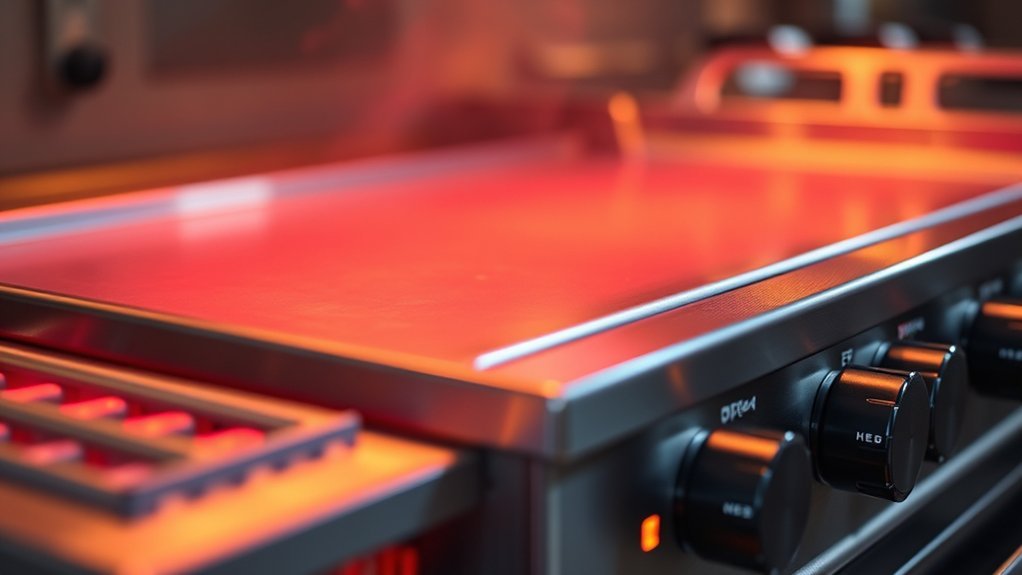

Much like how infrared saunas use radiant heat to warm your body efficiently, an infrared griddle uses infrared technology to cook food more effectively.
Instead of relying on direct contact heat from flames or coils, it emits infrared radiation that heats the cooking surface quickly and evenly.
This method reduces energy loss and minimizes hot spots.
Understanding exactly how it achieves these benefits requires a closer look at its technology and design.
Key Takeaways
- An infrared griddle uses infrared radiation to heat the cooking surface quickly and evenly through electromagnetic waves.
- It transfers heat via radiant energy, bypassing traditional conduction methods for faster cooking and reduced fuel use.
- Infrared heat penetrates food, minimizing energy loss and ensuring uniform cooking temperatures with fewer hot spots.
- These griddles often feature special coatings that improve heat distribution, durability, and precise temperature control.
- Infrared griddles offer superior energy efficiency, faster cooking times, and better heat portability compared to traditional griddles.
What Is an Infrared Griddle? How Does It Work?
An infrared griddle uses infrared radiation to transfer heat directly to the cooking surface, bypassing traditional conduction methods. When you operate one, infrared emitters generate electromagnetic waves that heat the griddle plate quickly and uniformly.
This process enhances energy efficiency by minimizing heat loss typical in conventional grills. However, you should consider infrared griddle drawbacks such as uneven cooking if the surface material doesn’t absorb radiation uniformly, and potential overheating spots.
Additionally, infrared systems may require precise calibration to maintain consistent temperatures, which can complicate usage. Despite these issues, the direct radiant heat ensures faster cooking and reduced fuel consumption.
Understanding these operational principles helps you evaluate whether an infrared griddle suits your specific cooking needs.
How an Infrared Griddle Differs From Traditional Models
Infrared griddles deliver heat through radiant energy, setting them apart from traditional models that rely primarily on conduction via heated metal surfaces. When you use an infrared griddle, you’ll notice superior infrared efficiency, as radiant heat directly penetrates food, reducing energy loss common in conduction methods.
This results in faster, more uniform cooking temperatures. Additionally, infrared griddles excel in heat portability; they transfer heat effectively without significant temperature drop when moved or adjusted. Traditional griddles often experience uneven hot spots and slower recovery times due to heat dissipating through the metal plate.
Top Benefits of Using an Infrared Griddle
Why should you consider switching to an infrared griddle for your cooking needs? Infrared griddles offer superior heat distribution thanks to advanced infrared coatings, which facilitate rapid and even heating across the surface.
This technology reduces hot spots and ensures consistent cooking temperatures, improving food quality and efficiency. Chef testimonials frequently highlight how these griddles cut down cooking times and enhance flavor retention by providing precise temperature control.
Additionally, infrared coatings increase the durability of the cooking surface, resisting corrosion and wear better than traditional griddles. By adopting an infrared griddle, you optimize energy use and achieve professional-grade results with less effort, making it a technically superior choice for both home cooks and culinary professionals seeking reliability and performance in one appliance.
Best Foods to Cook on an Infrared Griddle
When selecting foods for an infrared griddle, you’ll want to focus on items that benefit from rapid, even heat application and precise temperature control. Infrared grilling excels at searing proteins and cooking delicate griddle foods without flare-ups.
Items with uniform thickness cook best, ensuring consistent doneness.
| Food Type | Ideal Infrared Grilling Temp (°F) | Cooking Benefit |
|---|---|---|
| Steaks | 450-550 | Perfect sear, juicy inside |
| Pancakes | 350-375 | Even rise, no burning |
| Burgers | 400-500 | Quick sear, juicy center |
| Vegetables | 375-425 | Retains texture, caramelizes |
| Seafood | 375-425 | Gentle heat, prevents drying |
Use this guide to optimize your griddle foods for best infrared grilling results.
Key Features That Make an Infrared Griddle Stand Out
You’ll notice an infrared griddle stands out because it delivers even heat distribution across the cooking surface, preventing hot spots and ensuring consistent results. It also responds quickly to temperature changes, allowing precise control during cooking.
These features optimize efficiency and improve the overall cooking experience.
Even Heat Distribution
How does an infrared griddle achieve superior heat consistency across its surface? It leverages infrared efficiency to deliver even heat distribution with minimal fluctuation. Unlike conventional griddles relying on conduction, infrared griddles emit radiant energy that penetrates the cooking surface uniformly, eliminating hot spots.
This radiant heat transfers energy directly to your food, ensuring consistent cooking temperatures across the entire griddle. The design typically incorporates high-quality emissive materials that optimize infrared radiation, enhancing thermal uniformity.
As a result, you’ll experience precise temperature control and reliable heat spread, which reduces undercooked or overcooked areas. This even heat property not only improves cooking performance but also increases energy efficiency by minimizing heat loss and maximizing infrared transfer.
With such technical advantages, infrared griddles stand out for consistent, high-quality results.
Quick Temperature Response
Why does an infrared griddle respond so quickly to temperature adjustments? The answer lies in its heating mechanism. Unlike traditional griddles that rely on conduction through metal plates, an infrared griddle uses radiant energy to heat the cooking surface directly.
This direct energy transfer minimizes thermal lag, enabling a quick temperature response. When you adjust the heat setting, the infrared elements alter their output almost instantaneously, reducing response time significantly.
This means you can precisely control cooking temperatures without waiting for the surface to catch up, which is critical for delicate recipes or fast-paced cooking environments. The quick temperature response also improves energy efficiency since the griddle doesn’t waste heat maintaining unnecessary warmth.
How to Keep Your Infrared Griddle Clean and Ready to Use
When should you clean your infrared griddle to maintain optimal performance? Ideally, clean it immediately after each use once it cools down slightly but remains warm. This timing allows you to remove food residues efficiently, preserving crisp textures by preventing buildup that causes uneven heating.
Use a non-abrasive scraper to eliminate grease and debris, then wipe with a damp cloth. Regular cleaning enhances smoke control by reducing grease fires and smoke production during cooking. Avoid harsh chemicals; instead, opt for mild detergents if needed.
Periodically, deep clean the infrared elements following manufacturer guidelines to maintain heat distribution accuracy. Consistent, precise cleaning not only extends your griddle’s lifespan but also guarantees reliable temperature responsiveness, ensuring every meal benefits from optimal infrared cooking conditions.
Is an Infrared Griddle Worth the Investment for Your Kitchen?
You’ll want to evaluate how an infrared griddle’s cooking efficiency compares to your current setup, focusing on heat distribution and speed. Consider its durability and the maintenance required to keep performance consistent over time.
Finally, weigh the upfront cost against long-term benefits like energy savings and cooking quality to determine if it fits your kitchen needs.
Cooking Efficiency Comparison
Although infrared griddles often come with a higher upfront cost, their cooking efficiency can justify the investment by markedly reducing energy consumption and cooking times. By utilizing infrared radiation, these griddles deliver direct heat transfer to food, minimizing energy loss compared to conventional conduction-based griddles.
This results in faster preheating and more consistent cooking temperatures, which enhances overall energy efficiency. You’ll notice reduced fuel or electricity usage, translating to lower operational costs.
Additionally, infrared griddles maintain uniform heat distribution, preventing hot spots and ensuring even cooking, which further optimizes energy use. When comparing traditional griddles, the infrared model’s superior energy efficiency and cooking speed often lead to measurable improvements in kitchen productivity, making it a technically sound choice for professional and home cooks aiming to maximize efficiency.
Durability and Maintenance
Beyond cooking efficiency, the long-term value of an infrared griddle depends heavily on its durability and maintenance demands. You should consider durability concerns such as surface wear and electronic component longevity. Proper maintenance extends the griddle’s lifespan and ensures consistent performance.
Here are key durability concerns alongside essential maintenance tips:
| Durability Concerns | Maintenance Tips | Impact on Performance |
|---|---|---|
| Surface Scratches | Use non-abrasive tools | Prevents uneven heating |
| Electronic Sensitivity | Avoid moisture exposure | Ensures sensor accuracy |
| Heat Element Degradation | Regular calibration | Maintains temperature |
| Coating Wear | Apply protective oil | Reduces sticking |
Cost Versus Benefits
How do the upfront and ongoing costs of an infrared griddle compare to the tangible benefits it delivers in a professional or home kitchen? Conduct a thorough cost analysis, factoring in initial purchase price, energy efficiency, and maintenance expenses.
Infrared griddles often command higher upfront costs than conventional models but compensate through faster heat-up times and reduced fuel consumption, lowering operational costs. Their precision cooking enhances food quality, potentially increasing customer satisfaction or meal consistency.
Additionally, infrared griddles maintain strong resale value due to durable components and sustained demand in commercial markets. If you prioritize efficiency and long-term savings over initial expenditure, the investment proves justifiable.
However, if your usage is infrequent or budget constraints dominate, traditional griddles might offer better cost-effectiveness.
Frequently Asked Questions
Can I Use an Infrared Griddle Outdoors?
Yes, you can use an infrared griddle outdoors if it has sufficient outdoor durability and weather resistance. Ensure it’s designed to withstand moisture and temperature fluctuations to maintain performance and longevity during outdoor cooking sessions.
Are Infrared Griddles Energy Efficient Compared to Gas Models?
You’ll find infrared efficiency can boost energy savings by up to 30% compared to gas models.
In precise energy comparison, infrared griddles convert heat directly, reducing waste and delivering faster, more consistent cooking performance.
What Safety Precautions Should I Take When Using an Infrared Griddle?
You should ensure safe operation by keeping the infrared griddle clean, checking connections regularly, and avoiding water near electrical parts.
Maintenance tips include inspecting for damage and calibrating temperature controls to prevent overheating and hazards.
Can I Replace Parts on an Infrared Griddle if They Break?
You wouldn’t want to face a griddle meltdown worse than a volcanic eruption! Yes, you can replace parts on an infrared griddle, enhancing repair options, ensuring safety precautions, maintaining energy efficiency, and preserving cookware compatibility for reliable outdoor use.
Do Infrared Griddles Require Special Cookware or Accessories?
You don’t need special cookware for infrared griddles, but ensure cookware compatibility with flat, heat-conductive materials for optimal infrared griddle maintenance.
Avoid warped or uneven-bottomed pans to maintain consistent heat distribution and prolong griddle lifespan.
Conclusion
You might think an infrared griddle is just another gadget adding complexity to your kitchen, but it actually simplifies your cooking with precise, radiant heat that traditional models struggle to match. While it sounds high-tech, it’s surprisingly straightforward—delivering consistent temperatures and faster cooking without wasted energy.
If you’re tired of unevenly cooked meals, investing in one isn’t just smart; it’s ironically the easiest upgrade you’ll make for professional-level results. The benefits of an infrared griddle truly make it a standout choice for anyone looking to improve their cooking experience.