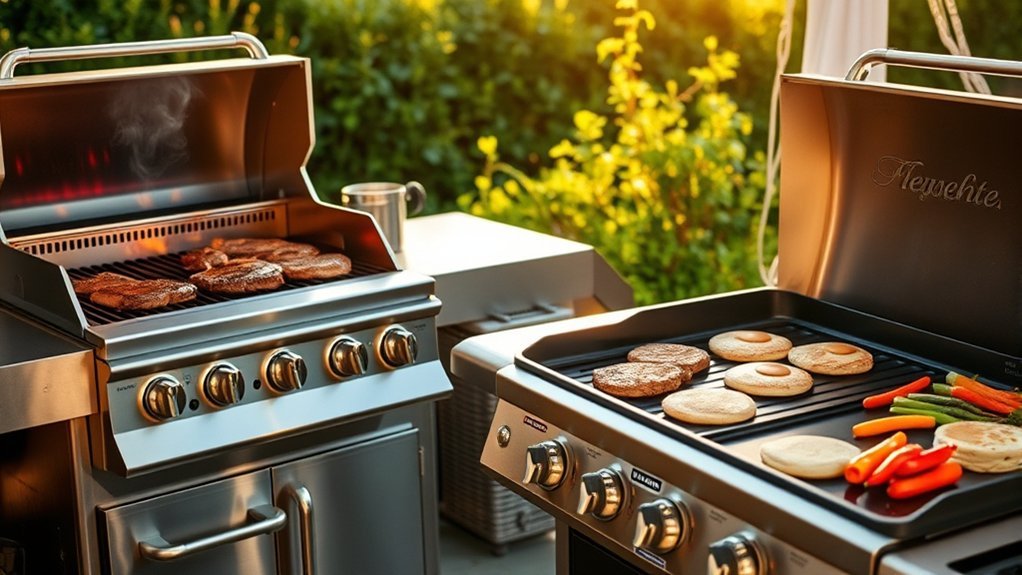

When deciding between a gas grill or gas griddle, you’ll want to contemplate how you cook and the flavors you prefer. A gas grill gives you that classic sear and smoky char, perfect for steaks and burgers.
Meanwhile, a gas griddle offers even heat and versatility, great for everything from pancakes to seafood. Your choice depends on space, cooking style, and cleanup ease—factors that can greatly shape your outdoor cooking experience.
Key Takeaways
- Gas grills provide direct flame and searing with char marks, ideal for traditional BBQ flavors and high-heat cooking.
- Gas griddles offer even heat distribution and a flat surface, perfect for delicate foods like pancakes, eggs, and stir-fries.
- Griddles require less maintenance and cleaning, with easier surface wipe-downs compared to grills’ grate brushing.
- Gas grills need more outdoor space and fuel due to uneven heat zones and flare-ups, while griddles fit compact areas efficiently.
- Choose grills for large gatherings and classic grilling; opt for griddles for versatile, quick meals and precise temperature control.
Main Differences Between Gas Grills and Griddles
How do gas grills and gas griddles differ in their design and cooking style? When you use a gas grill, you’re working with open grates that allow direct flame contact, ideal for searing and creating grill marks.
Gas grills feature open grates for direct flame contact, perfect for searing and achieving classic grill marks.
In contrast, a gas griddle features a flat, solid surface, giving you even heat distribution and versatility to cook delicate items like pancakes or eggs without falling through gaps.
Regarding propellant differences, both typically use propane or natural gas, but grills often require higher BTU output for intense, direct heat, while griddles operate efficiently at moderate levels for consistent surface cooking.
Choosing between the grill griddle depends on whether you want the char and flare of grilling or the broad, steady surface for varied dishes.
Flavor and Searing Benefits of Gas Grills
Why do many outdoor cooking enthusiasts prefer gas grills for flavor and searing? Gas grills excel in flavor optimization by allowing fat to drip onto hot burners, creating flavorful smoke that infuses your food. This process enhances the taste in ways a gas griddle can’t replicate.
When it comes to searing efficiency, gas grills deliver intense, direct heat through grates, which quickly caramelizes the surface of meats and vegetables, locking in juices and texture. You’ll notice distinct grill marks, a sign of high searing efficiency, that gas griddles typically lack.
While griddles offer uniform heat, gas grills provide that signature char and smoky flavor that many chefs and home cooks seek for outdoor cooking. This makes gas grills a top choice for flavor-focused grilling.
Why Gas Griddles Offer More Versatility
You’ll find that gas griddles offer a more flexible cooking surface compared to grills, letting you prepare a wider variety of foods from pancakes to stir-fries. Their precise temperature control helps you cook delicate items evenly without burning.
This adaptability makes gas griddles a versatile choice for any meal.
Cooking Surface Flexibility
Although both gas grills and gas griddles offer reliable cooking options, gas griddles provide a more flexible surface that lets you cook a wider variety of foods at once. The flat, continuous surface of a gas griddle means you can easily prepare items that require different heat zones or need to be cooked evenly without falling through grates. This surface flexibility allows you to multitask efficiently.
| Cooking Surface | Gas Grill | Gas Griddle |
|---|---|---|
| Surface Type | Grates with gaps | Flat, solid surface |
| Food Stability | Limited (gaps cause slipping) | High (stable, no gaps) |
| Heat Zones | Indirect and direct zones | Multiple zones on one surface |
| Cleaning Ease | Moderate | Easy |
| Cooking Styles | Grilling only | Grilling, frying, sautéing |
Gas griddles clearly offer superior surface flexibility for diverse cooking styles.
Variety of Food Options
How many different dishes do you want to prepare at once? Gas griddles give you the freedom to cook a wider variety of foods simultaneously compared to gas grills. Their flat, spacious surface lets you handle pancakes, eggs, vegetables, and seafood all at once without cross-contamination or flare-ups common on grills.
This versatility isn’t just about quantity but also about types of food. While grills excel in searing meats with grill marks, griddles accommodate delicate items and smaller, loose ingredients that would fall through grill grates. When considering two word discussion ideas like “food versatility” or “meal variety,” griddles clearly lead.
Temperature Control Precision
Why does temperature control matter so much when choosing between a gas grill and a gas griddle? It’s all about how precisely you can manage heat. Gas griddles offer superior temperature precision thanks to their flat cooking surface and advanced heat mapping.
Unlike gas grills, which often have hot and cold spots due to uneven grill grates and open flames, griddles distribute heat evenly across the entire surface. This consistent heat mapping means you can cook multiple foods at different temperatures simultaneously, giving you more versatility.
When you need exact control, whether searing, simmering, or keeping food warm, a gas griddle responds faster and maintains temperature steadier than a gas grill. So, if temperature precision is a priority, a gas griddle clearly holds the edge.
Fuel Use and Heat Control: What You Need to Know
When it comes to fuel use and heat control, understanding the differences between a gas grill and a gas griddle can help you make the best choice for your cooking needs. Gas griddles typically offer more consistent heat distribution across the entire cooking surface, which means you’ll use fuel more efficiently and enjoy better fuel economy.
In contrast, gas grills often have hot spots due to uneven heat distribution, requiring you to adjust burners frequently to maintain even cooking. While both appliances allow you to control temperature, griddles provide smoother, more precise heat control, making it easier to cook delicate foods without burning.
If fuel economy and consistent heat are priorities, a gas griddle might serve you better, but for traditional grilling flavors, a gas grill remains a solid option.
Cleaning and Maintenance for Gas Grills and Griddles
You’ll find that cleaning a gas grill often requires scrubbing grates and clearing drip trays, while a griddle needs a thorough wipe-down of its flat surface after each use.
Maintenance for grills may be less frequent but involves more detailed checks, whereas griddles benefit from regular seasoning to prevent rust. Understanding these differences helps you keep your equipment in top shape with minimal effort.
Cleaning Techniques Comparison
Although both gas grills and gas griddles require regular cleaning to maintain performance, their surfaces and designs demand different techniques. When cleaning grease, you’ll find that gas grills with grates need brushing to remove residue from between bars, while gas griddles have flat surfaces that require scraping to clear off grease and food particles.
For maintenance stains, grills often benefit from wire brushes or grill stones, whereas griddles respond better to scrapers and mild detergents to avoid damaging the cooking surface. Additionally, griddles typically need you to season the surface after cleaning to prevent rust, a step unnecessary with most grills.
Understanding these distinctions helps you tailor your cleaning routine, ensuring both appliances stay efficient and hygienic without wasting effort or risking damage.
Maintenance Frequency Tips
Regularly maintaining your gas grill or griddle ensures best performance and longevity, but the frequency varies based on usage and appliance type. For gas grills, cleaning the grates and burners after every few uses prevents buildup, while a deep clean every 3-6 months preserves functionality.
Gas griddles require wiping the surface after each use and occasional seasoning to avoid rust. Your maintenance frequency should increase with heavy use, especially during grilling seasons. Longevity tips include inspecting gas connections and replacing worn parts promptly.
Compared to grills, griddles often need more frequent surface care but less burner maintenance. By tailoring your cleaning schedule to the appliance and usage, you’ll extend its lifespan and ensure safer, more efficient cooking. Consistency here is key to maximizing your investment.
Matching Gas Grills and Griddles to Your Space and Lifestyle
How do you choose between a gas grill and a gas griddle based on your available space and cooking habits? If you have limited outdoor space, a gas griddle often offers a more space-saving solution with its compact, flat design.
It fits neatly on small patios, enhancing outdoor dining synergy by allowing you to cook multiple items at once without crowding your setup. Conversely, gas grills usually require more room but provide direct flame cooking, ideal if you enjoy traditional grilling.
Consider your lifestyle: if you prefer quick, versatile meals and smaller gatherings, a griddle might suit you better. If you host larger barbecues and savor classic grilled flavors, a gas grill aligns well with your needs.
Matching your equipment to your space and habits ensures efficient, enjoyable outdoor cooking.
Best Meals to Cook on Gas Grills and Griddles
What types of meals shine best on gas grills versus gas griddles? When you prioritize seasonal grilling and fuel economy, your meal choices can make a big difference.
Gas grills excel at high-heat, direct cooking, giving you those classic char marks and smoky flavors. Gas griddles, however, offer a flat, even surface ideal for cooking delicate or small items without flare-ups.
Here’s what works best:
- Gas Grill: steaks, burgers, chicken breasts, kebabs, corn on the cob
- Gas Griddle: pancakes, eggs, stir-fried veggies, seafood, breakfast sandwiches
Choosing the Right Gas Grill or Griddle for Your Backyard
When selecting a gas grill or griddle for your backyard, you’ll want to contemplate how each fits your cooking style and space. Consider surface material first: stainless steel griddles offer even heating and easy cleaning, while cast iron grills provide superior heat retention and distinctive sear marks.
Think about weather impact as well; stainless steel resists rust better, ideal for humid climates, whereas regular maintenance is crucial for cast iron to avoid corrosion. Space constraints also matter. Griddles often have a larger flat cooking area, perfect for versatile meals, while grills focus on direct heat for traditional BBQ flavors.
Frequently Asked Questions
Can Gas Grills or Griddles Be Used Indoors Safely?
You can’t safely use gas grills or griddles indoors without proper ventilation. Both require excellent indoor safety measures, including ventilation systems that remove carbon monoxide and fumes.
These precautions help prevent health hazards and assure safe cooking environments.
Are Gas Grills or Griddles More Cost-Effective Long-Term?
You’ll find gas griddles more cost-effective long-term due to lower gas cost and simpler maintenance.
Gas grills often use more fuel and require frequent cleaning, increasing both gas cost and maintenance cost over time.
Do Gas Grills or Griddles Require Specific Propane Tank Sizes?
When it comes to propane tanks, you can’t paint with one brush; gas grills and griddles often need specific sizes.
You’ll want to follow propane regulations closely for indoor safety and optimal performance.
Can I Convert a Gas Grill Into a Griddle Easily?
You can convert your grill with a griddle upgrade, but expect some differences in oxidize textures and flavor profiles.
While the process is straightforward, it changes cooking dynamics, so consider how you want your food to cook.
What Accessories Are Essential for Gas Grills and Griddles?
You’ll want grill accessories like tongs, a spatula, and a grill brush for cleaning.
For griddle essentials, grab a scraper, oil dispenser, and a flat spatula. Both need heat-resistant gloves for safety.
Conclusion
So, whether you crave that smoky grill char or the smooth precision of a griddle’s even heat, your choice says a lot about your cooking style—and your patience for cleanup. If you want classic BBQ flair and don’t mind juggling hot spots, the grill’s your buddy.
But if versatility and easy handling sound better, the griddle’s got your back. Either way, you’re winning—just don’t blame us when your neighbors start craving your cooking!
When deciding between a gas grill or gas griddle, consider what suits your cooking preferences best to make the most of your outdoor meals.