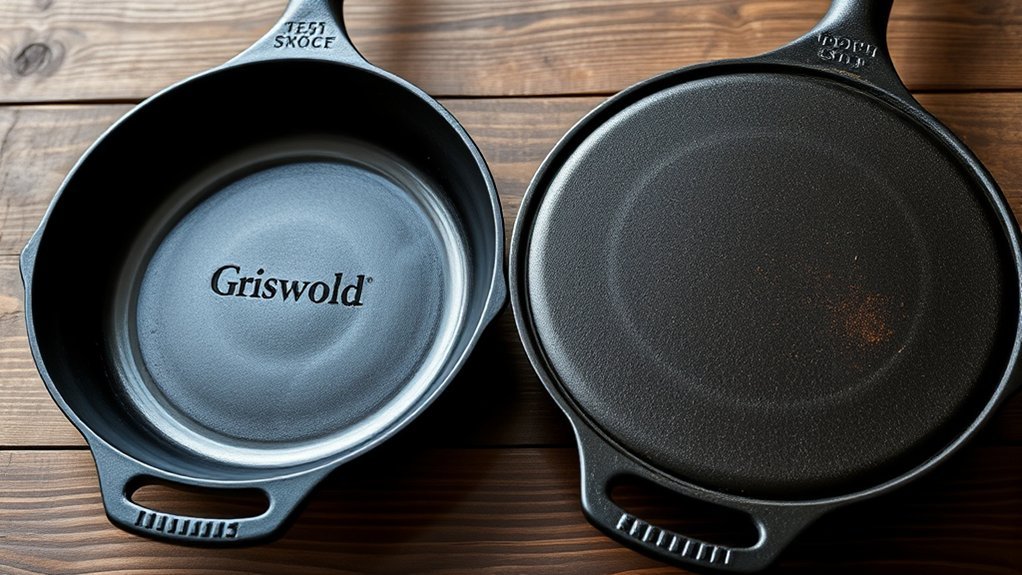

When you’re examining a Griswold skillet, your first focus should be on the logo and overall shape—these details reveal much about its authenticity. Spotting a fake Griswold skillet starts with recognizing the distinct, blocky “Griswold” logo enclosed within a carefully crafted oval or rectangle, consistent with their production era.
Beyond the markings, subtle cues in casting quality and handle design can expose imitations. Genuine pieces exhibit precise craftsmanship that counterfeit versions often lack. Understanding these nuances will help you avoid common pitfalls collectors often miss.
Key Takeaways
- Check for the classic “Griswold” script logo centered on the base with clear, blocky lettering inside a smooth oval or slanted rectangle shape.
- Verify the presence of a unique heat ring on the cooking surface and consistent skillet dimensions to confirm authenticity.
- Inspect casting quality for smooth, sharp lines, even wall thickness, and absence of rough seams, bubbles, or excessive flash lines.
- Ensure the handle is ergonomic with a smooth taper, correct length relative to skillet size, and crisp “Slant Logo” or “Block Logo” near the base.
- Feel the skillet’s weight for balanced heft typical of historic American foundry cast iron, avoiding pieces that feel too light or uneven.
Key Features of Authentic Griswold Skillets
How can you tell an authentic Griswold skillet from a counterfeit? Start by examining key features that experts rely on for authentic grading. Genuine Griswold skillets, produced between the late 19th century and mid-20th century, showcase precise craftsmanship, smooth surfaces, and a distinctive glossy black enamel finish inside the pan.
The skillet’s weight feels balanced, reflecting the superior cast iron quality sourced historically from trusted American foundries. The handle design is ergonomic, subtly curved with a clean pour spout. Historical sourcing reveals that Griswold skillets maintain consistent dimensions and a unique heat ring on the cooking surface, which counterfeiters often miss.
Identifying Authentic Griswold Markings
Where can you find the telltale signs that distinguish an authentic Griswold skillet? You need to closely examine the skillet’s markings, which serve as the brand’s signature. Griswold skillets feature specific authentic markings that collectors rely on to verify legitimacy.
These include:
- The iconic “Griswold” script logo, often found in the center of the skillet’s base.
- The “Erie” location stamp beneath the logo, indicating production in Erie, Pennsylvania.
- Distinct weight indicators, usually embossed near the skillet’s handle or base, reflecting the skillet’s size and heft.
- Precise serial numbers or size designations, which align with historical manufacturing records.
Judging Casting Quality on Griswold Skillets
Why does casting quality matter when evaluating a Griswold skillet? Griswold Manufacturing was renowned for its precise, high-grade castings, reflecting craftsmanship from the early 1900s through mid-century.
When you discuss casting quality, focus on the skillet’s smoothness and uniformity. Genuine Griswolds have clean, sharp lines and well-defined details, no rough edges or inconsistent textures.
You should assess finish variance carefully; authentic skillets show minimal surface inconsistencies, with a consistent patina or factory finish. Variations often indicate inferior reproduction methods or counterfeit pieces.
Recognizing Genuine Handle Shapes and Sizes
When examining a Griswold skillet, what should you look for in its handle to confirm authenticity? Recognizing handles is essential since authentic handles exhibit precise shapes and sizes developed over decades. Genuine handles feature a smooth, slightly rounded contour with a gradual taper.
You’ll notice identifying logo placement near the handle’s base, often with subtle marking variations depending on production era.
Focus on these key points:
- Handle length matches skillet size; too short or thick suggests a fake.
- The “Slant Logo” or “Block Logo” near the handle base must be clear and well-defined.
- Authentic handles have a subtle curve, not sharp or angular edges.
- Look for consistent casting quality without rough seams or bubbles.
Mastering these details helps you distinguish authentic handles from replicas confidently.
Understanding Weight, Thickness, and Surface Finish
You’ll notice authentic Griswold skillets have a distinct weight and thickness that’s hard to replicate, often feeling sturdier than fakes.
Pay close attention to the surface finish, as genuine pieces feature a smooth, refined texture developed through decades-old casting methods. Comparing these physical traits side-by-side can quickly reveal inconsistencies in counterfeit versions.
Weight Comparison Tips
How can you distinguish an authentic Griswold skillet from a counterfeit by weight alone? Weight comparison is a critical authenticity cue because genuine Griswold skillets have a distinct heft due to their specific iron composition and casting methods used from the late 1800s to mid-1900s. Here’s what you should note:
- Consistent Weight: Authentic pieces maintain a consistent weight range matching documented Griswold standards.
- Thickness Matters: Genuine skillets have evenly thick walls; fakes often feel lighter from thinner casting.
- Edge Weight: Check the skillet’s rim and handle weight; originals balance weight distribution expertly.
- Historical Reference: Compare with verified Griswold weights published in collector guides for accuracy.
Using these weight comparison tips, you can accurately identify authenticity cues without relying on surface texture analysis.
Surface Texture Differences
Weight and thickness offer valuable clues, but examining the surface texture reveals additional layers of authenticity in Griswold skillets. Genuine Griswolds feature a smooth, finely pitted surface texture resulting from precise sand casting techniques used between the early 1900s and 1950s.
This texture isn’t overly rough or glossy but maintains a matte finish consistency that fakes often fail to replicate. Counterfeit skillets may show uneven surface textures, inconsistent finish consistency, or overly polished areas that deviate from Griswold’s hallmark subtle grit.
When you run your fingers across an authentic Griswold, you’ll notice a uniform, tactile feel that speaks to its craftsmanship and era. Paying close attention to these subtle surface details helps you distinguish a true collector’s piece from a counterfeit with confidence.
Verifying Seller Reputation and Skillet Provenance
Where can you find trustworthy information about a Griswold skillet’s authenticity? To verify seller credibility and conduct provenance checks, start with these steps:
- Research Seller History: Check reviews, ratings, and past sales for consistency and transparency.
- Request Detailed Provenance: Insist on documented ownership history or original purchase receipts.
- Consult Expert Forums: Engage with collector communities and vintage cookware experts for seller insights.
- Cross-Verify Listings: Compare skillet details across multiple platforms to identify discrepancies.
Griswold skillets, produced from the late 1800s to the mid-20th century, have distinct manufacturing marks. Sellers with solid provenance can confirm these details, ensuring the skillet’s authenticity.
Common Fake Griswold Skillet Patterns to Avoid
When examining Griswold skillets, pay close attention to handle markings, as authentic pieces feature precise, consistent stamps reflecting early 20th-century manufacturing standards. Notice subtle logo shape variations. Genuine Griswold logos have distinct details that many counterfeits miss.
Also, assess casting quality. Original skillets boast smooth, sharp edges and uniform surfaces, unlike the rough, uneven finishes common in fakes.
Handle Markings Differences
How can you tell if the handle markings on a Griswold skillet are genuine or counterfeit? Authentic Griswold skillets feature precise handle markings with notable scale consistency, reflecting the manufacturer’s quality standards from the early 20th century.
When examining handle markings, focus on:
- Crispness: Genuine markings are sharply cast, not blurry or shallow.
- Font Style: Originals use consistent, historic font styles unique to Griswold.
- Positioning: Authentic markings align symmetrically along the handle’s centerline.
- Scale Consistency: The size and spacing of letters maintain uniformity across the handle.
Fake skillets often show irregular scale, uneven lettering, or misplaced marks. Knowing these specifics helps you confidently distinguish between real and counterfeit Griswold handle markings, preserving your collection’s authenticity.
Logo Shape Variations
Why do logo shapes matter so much when identifying a genuine Griswold skillet? Authentic Griswold logos have distinct shapes that collectors have studied for decades. Variations in logo shape often signal reproduction or counterfeit pieces, so understanding these variation types is crucial to avoid fakes.
Genuine logos typically feature a blocky, well-defined “Griswold” inside a smooth, oval or slanted rectangle shape.
| Logo Shape Variation | Description |
|---|---|
| Oval | Classic, smooth edges, well-spaced letters |
| Slanted Rectangle | Angled shape with clear font |
| Rounded Rectangle | Soft corners, consistent lettering |
| Irregular Oval | Edges uneven, letters crowded |
| Blurred Rectangle | Fuzzy edges, inconsistent font |
Knowing these logo shape variations helps you quickly spot common fake Griswold skillet patterns to avoid.
Casting Quality Indicators
Once you’ve learned to recognize authentic Griswold logo shapes, the next step is to examine the skillet’s casting quality, an often overlooked but telling indicator of authenticity. Spotting forgeries hinges on identifying mold casting flaws absent in genuine pieces.
Griswold skillets, produced from the late 19th to mid-20th century, feature crisp, smooth surfaces and uniform thickness.
Look out for these common mold casting flaws:
- Rough or pitted surfaces: Genuine Griswold castings are smooth with minimal imperfections.
- Inconsistent thickness: Authentic skillets have even wall thickness; variations signal poor molds.
- Blurry or misshapen details: Fakes often show distorted logo edges or numbers.
- Excessive flash lines: Overly prominent mold seams indicate inferior reproduction techniques.
Pay close attention to these indicators when spotting forgeries.
Frequently Asked Questions
How Should I Clean and Maintain a Griswold Skillet?
You should clean your Griswold skillet with mild soap and avoid harsh scrubbing. Regularly restore seasoning by applying thin layers of oil.
Understanding how to identify counterfeit finishes helps ensure authentic care. This preserves its historic, expertly crafted cast iron surface for generations.
Can Griswold Skillets Be Used on Induction Cooktops?
You’ll feel the skillet’s heavy cast iron warmly embrace your induction cooktop, confirming its induction compatibility. Griswold skillets offer even heat distribution, a legacy of craftsmanship from the early 1900s, perfect for precise cooking.
What Is the History Behind the Griswold Brand?
You’ll appreciate Griswold’s rich history, rooted in authentic craftsmanship from Erie, Pennsylvania. When sourcing, verify provenance carefully to ensure genuine pieces, as their detailed designs and quality reflect the brand’s enduring legacy and authenticity.
Are Griswold Skillets Safe for Oven Use?
You can safely use Griswold skillets in the oven, especially those with original old grading marks and authentic handles. Their cast iron construction withstands high heat, reflecting Griswold’s historic quality and craftsmanship standards.
How Do Griswold Skillets Compare to Wagner Skillets?
When you weigh Griswold vs. Wagner, you’re holding history in your hands. Griswold’s smoother finish and precise craftsmanship often outshine Wagner’s sturdier, rustic feel.
Skillet authenticity hinges on these subtle but telling details.
Conclusion
When you spot a skillet with a blurry Griswold logo or uneven casting, like a collector who once bought a “vintage” piece only to find mismatched handle proportions and off-era markings, you know it’s fake.
Trust your eye for crisp, era-consistent logos and smooth, uniform surfaces. By applying these detailed checks rooted in Griswold’s rich Erie heritage, you’ll confidently distinguish genuine skillets from clever counterfeits every time.
Mastering these skills is key to how to spot a fake Griswold skillet with certainty.