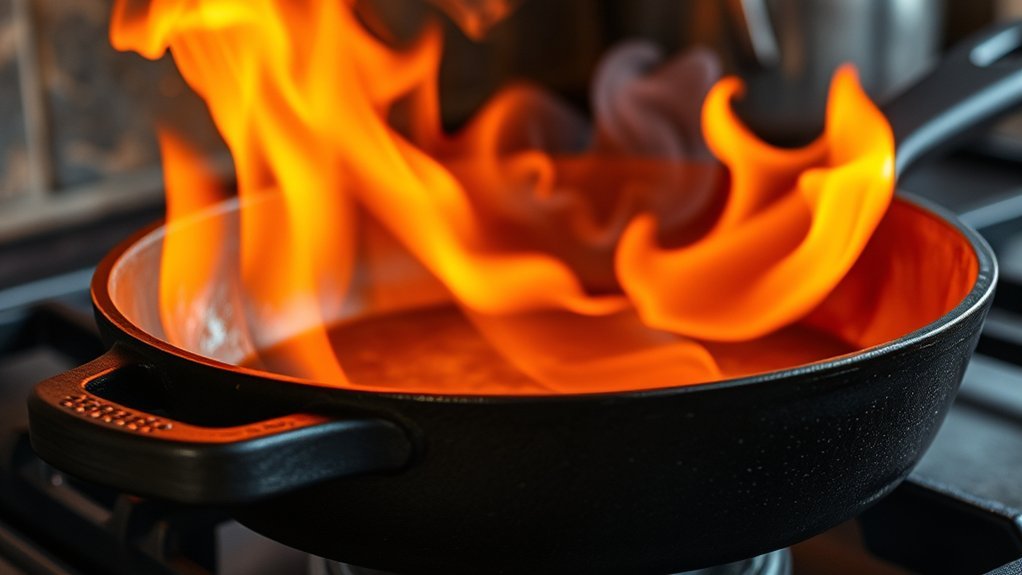

You might not realize that a cast iron skillet’s surface can easily reach temperatures between 400 and 500°F during searing, with brief spikes exceeding 700°F under direct flame. Understanding how hot a cast iron skillet can get is essential for effective cooking and maintenance.
Yet, pushing these limits risks damaging the skillet’s seasoning and structural integrity. Understanding how heat interacts with the skillet’s material and seasoning is crucial if you want to manage temperature effectively and preserve your cookware’s performance.
Let’s explore what determines these temperature thresholds and how to control them.
Key Takeaways
- Cast iron skillets can reach temperatures up to 700°F (370°C) on a standard stovetop.
- Safe operational cooking temperatures are commonly kept below 500°F (260°C) to protect seasoning.
- Exceeding 500°F risks damaging the seasoning layer and may cause warping or microscopic cracks.
- Cast iron skillets retain heat well due to high thermal mass, causing temperature overshoot if not monitored.
- Oven use is safe for cast iron, allowing consistent heat without exceeding safe seasoning limits.
How Hot Do Cast Iron Skillets Get?
How hot can a cast iron skillet actually get? Typically, cast iron can reach temperatures up to 700°F (370°C) on a standard stovetop, but pushing beyond this approaches its searing limits. At these high temperatures, you can achieve perfect sears, but be cautious. Exceeding searing limits risks damaging the skillet’s seasoning.
Seasoning effects play a critical role in temperature tolerance; a well-maintained seasoning layer acts as a protective barrier, enhancing heat distribution and preventing rust. However, if the skillet overheats repeatedly, the seasoning can degrade, leading to flaking or sticking.
Factors Influencing Cast Iron Skillet Temperature
Understanding the maximum temperature a cast iron skillet can reach is only part of the equation; several factors influence how hot your skillet gets during cooking. First, the heat source intensity and distribution directly affect skillet temperature. Gas burners provide rapid, adjustable heat, while electric elements heat more slowly.
Second, the presence of heated oil alters thermal transfer; oil’s smoke point limits surface temperature before degradation occurs. Third, the skillet’s metal seasoning, the polymerized oil layer bonded to the iron, impacts heat absorption and retention, affecting temperature stability.
Finally, skillet thickness and mass determine thermal inertia, influencing how quickly and evenly heat spreads. By controlling these variables, you can optimize your skillet’s temperature for precise cooking outcomes.
Measuring Cast Iron Skillet Temperature
When determining the exact temperature of your cast iron skillet, what methods can you rely on to ensure accuracy? Two word ideas such as “infrared thermometer” and “thermocouple probe” are essential for precise temperature measurement.
An infrared thermometer allows you to gauge surface heat quickly without contact, ensuring you capture the skillet’s temperature at specific points. Meanwhile, a thermocouple probe provides direct, real-time readings by inserting into the skillet, offering detailed thermal data.
Both tools eliminate guesswork, enabling you to monitor temperature fluctuations accurately. While traditional methods like water droplet tests offer rough estimates, they lack the precision required for scientific analysis.
Employing these two word ideas in temperature measurement will help you achieve reliable, replicable results when managing your cast iron’s heat.
Safe Temperature Limits for Cast Iron Skillets
At what temperature does a cast iron skillet reach its safe operational limit? Generally, cast iron can withstand temperatures up to 500°F (260°C) without compromising its structural integrity or seasoning.
When you use a hot skillet within this range, you ensure optimal cooking performance while preserving its durability. Cast iron is oven safe, allowing you to transition seamlessly from stovetop to oven at these temperatures.
Exceeding 500°F risks damaging the seasoning layer and may cause thermal stress, though the skillet itself rarely cracks under typical cooking conditions. To maintain safety and skillet longevity, avoid direct exposure to open flames or broilers that push temperatures beyond this threshold.
Monitoring temperature helps you use your cast iron effectively and safely.
What Happens When Cast Iron Skillets Overheat?
How does overheating affect your cast iron skillet’s performance and longevity? Excessive heat can degrade the skillet’s structure and compromise its seasoning effects.
When you overheat cast iron, the metal may warp or develop microscopic cracks, reducing its durability. Additionally, overheating can break down the polymerized oil layer that forms the non-stick seasoning, causing it to flake or burn off.
This deterioration not only diminishes the skillet’s cooking efficiency but also increases the risk of rust. For overheating prevention, you should gradually heat the skillet and avoid exposing it to open flames beyond recommended temperatures.
Proper temperature control preserves both the skillet’s integrity and its seasoning effects, ensuring optimal performance and extending its usable life.
Heat Distribution in Cast Iron Skillets
Overheating a cast iron skillet not only risks damaging its structure but also affects how heat spreads across its surface. You need to understand that heat conduction in cast iron is slower yet more uniform compared to other materials.
Over time, seasoning aging alters the skillet’s surface properties, impacting heat distribution efficiency. An older, well-seasoned skillet typically exhibits more consistent heat spread due to improved thermal contact.
| Factor | Effect on Heat Distribution |
|---|---|
| Heat Conduction | Slow but even, minimizes hot spots |
| Seasoning Aging | Enhances surface uniformity |
| Overheating | Causes uneven heat, warping risks |
Monitoring these variables helps you optimize cooking performance and longevity of your cast iron skillet.
Tips for Heating Cast Iron Skillets Evenly and Quickly
Why does it take so long for cast iron skillets to heat evenly? Cast iron’s high density and thickness cause slow thermal conduction, delaying uniform temperature distribution.
To heat your skillet evenly and quickly, start by placing it on medium heat rather than high; this prevents hotspots and allows gradual heat transfer. Preheating for at least 5–10 minutes ensures the entire surface reaches optimum temperature, enhancing searing precision.
Avoid sudden temperature changes, which can cause thermal stress and uneven heating. Using a lid can trap heat and improve heat retention, accelerating the heating process.
Finally, regularly maintaining your skillet’s seasoning layer maximizes heat absorption and distribution, supporting consistent cooking performance. These methods maximize your skillet’s thermal properties without compromising its integrity.
Best Cooking Techniques by Cast Iron Skillet Temperature
You’ll want to adjust your cast iron skillet’s temperature based on the cooking technique. High heat is ideal for searing and browning, creating a Maillard reaction that locks in flavor.
For low and slow cooking, maintain a moderate temperature to ensure even heat distribution and tender results.
Searing and Browning
How hot should your cast iron skillet get for optimal searing and browning? Aim for a surface temperature between 400°F and 500°F. This range triggers the Maillard reaction efficiently, creating a flavorful crust without burning.
Use infrared thermometers or preheat for 5-10 minutes on medium-high heat to reach this target. Effective searing techniques involve patting proteins dry and avoiding overcrowding, which reduces skillet temperature and hinders browning.
For browning tips, ensure the skillet is evenly heated; uneven heat causes inconsistent color and texture. Add minimal oil with a high smoke point to prevent burning. Mastering this temperature control maximizes flavor development and texture, making your cast iron skillet indispensable for perfect sears and browns.
Low and Slow
When should you lower the heat and rely on slow cooking in a cast iron skillet? You engage the low slow method primarily when cooking delicate proteins, tenderizing tough cuts, or when ingredients require even heat penetration without burning.
Precise temperature control is essential; cast iron’s excellent heat retention means once heated, it remains hot, so you must reduce the stove setting to maintain a steady low slow temperature typically between 200°F and 300°F. This prevents surface charring while allowing internal cooking to progress uniformly.
Use this technique for braising, simmering, or gentle sautéing. Remember, managing temperature control on cast iron is critical since its thermal mass can cause overshooting if heat isn’t adjusted promptly.
Mastering low slow cooking maximizes flavor development and texture without compromising the skillet’s seasoning layer.
Frequently Asked Questions
How Do I Season a Cast Iron Skillet Properly?
You start seasoning basics by cleaning and drying your skillet thoroughly. Then, apply a thin layer of oil choices like flaxseed or vegetable oil.
Bake upside down at 450°F for an hour, repeating for durability.
Can Cast Iron Skillets Be Used on Induction Cooktops?
Yes, cast iron skillets have excellent induction compatibility due to their ferromagnetic nature. Their high heat tolerance guarantees efficient cooking on induction cooktops, which typically operate between 100°C to 250°C, optimizing energy transfer precisely.
What Is the Best Way to Clean a Cast Iron Skillet?
You should clean your cast iron skillet using hot water and a stiff brush, avoiding soap to preserve seasoning.
Debunk maintenance myths by skipping harsh detergents or soaking, which damage the seasoning and reduce lifespan.
How Long Does a Cast Iron Skillet Retain Heat?
You’ll feel your cast iron skillet hold heat like a miniature sun, retaining it efficiently for 20 to 30 minutes. This longevity depends on thickness, material, and heat source, ensuring consistent cooking performance even after removing from heat.
Are Cast Iron Skillets Safe for Oven Use?
Yes, cast iron skillets are safe for oven use. Their two-word feature, heat retention, allows even cooking at high temperatures.
Just avoid sudden temperature changes to prevent thermal shock and maintain the skillet’s durability over time.
Conclusion
You’ll see your cast iron skillet glow with controlled heat, reaching up to 500°F for perfect searing.
But beware the temptation of flames pushing beyond 700°F—this risks cracking your seasoning and the pan itself. By monitoring surface temperatures and managing heat gradually, you harness the skillet’s heavy mass for even, consistent cooking.
Mastering this balance lets you unlock cast iron’s full potential, ensuring durability and flawless heat distribution every time you cook. Understanding how hot a cast iron skillet can get is key to achieving these results.