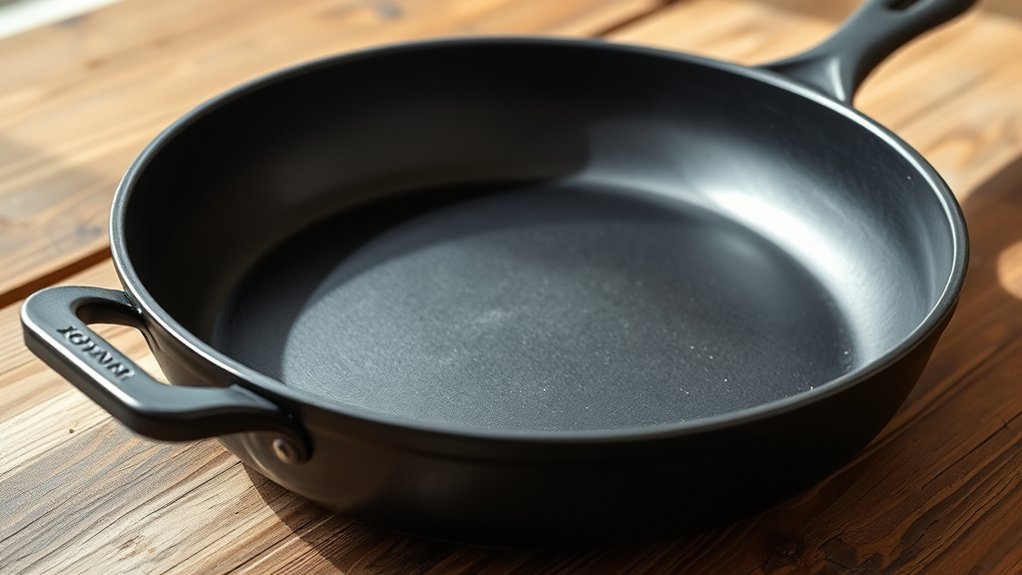

When you choose a carbon steel skillet, you’re selecting a pan forged from iron alloyed with a precise carbon content, typically between 0.5% and 1.0%.
This balance enhances hardness and durability without sacrificing malleability, allowing for quick, even heating and superior temperature control.
Its unique surface evolves through seasoning, creating a natural non-stick layer that improves with use.
But understanding how these properties interact will help you maximize its potential in your kitchen.
Key Takeaways
- A carbon steel skillet is a cookware made primarily of iron alloyed with 0.5%-1.0% carbon for hardness and durability.
- It heats quickly and distributes heat evenly, allowing precise temperature control for various cooking methods.
- The skillet develops a natural non-stick surface through seasoning, where heated oil polymerizes into a durable coating.
- Carbon steel skillets are lighter and smoother than cast iron, making them easier to handle and season.
- Proper care involves cleaning without soap, drying immediately, oiling after use, and storing in a dry place to prevent rust.
What Carbon Steel Skillets Are Made Of
Carbon steel skillets consist primarily of an alloy made from iron and a controlled amount of carbon, typically ranging between 0.5% and 1.0%. This precise metal alloying enhances hardness and durability while maintaining malleability, essential for shaping the skillet.
The carbon content influences the skillet’s ability to develop a natural non-stick patina over time. From an environmental impact perspective, carbon steel production demands less energy and raw materials compared to stainless steel, making it a more sustainable choice. Additionally, carbon steel’s recyclability reduces waste and conserves resources.
However, the manufacturing process requires careful control of alloy composition to optimize performance and minimize ecological footprint. When you choose a carbon steel skillet, you’re selecting a thoughtfully engineered tool that balances functional quality with environmental considerations.
How Carbon Steel Skillets Heat Up and Cook Your Food
A skillet made from carbon steel heats quickly and distributes heat evenly across its surface, giving you precise control over cooking temperatures. This efficient heat conduction ensures your food cooks uniformly, reducing hot spots.
When you preheat the pan, the metal’s rapid response allows you to adjust heat levels instantly. As you add oil, it undergoes polymerization, creating a thin, durable layer that enhances cooking performance by improving heat transfer and reducing sticking.
| Factor | Impact on Cooking |
|---|---|
| Heat Conduction | Uniform temperature, precise control |
| Rapid Heating | Quick temperature adjustments |
| Oil Polymerization | Improved heat transfer, reduced sticking |
Using these properties, you’ll achieve consistent, professional-quality results every time.
How Carbon Steel Skillets Develop a Natural Non-Stick Surface
You develop a natural non-stick surface on your carbon steel skillet through a seasoning process that involves heating oil until it polymerizes, creating a durable, slick coating.
This polymerization bonds oil molecules to the skillet’s surface at a molecular level, enhancing its resistance to sticking. With regular use, this layer thickens and improves, making your skillet more efficient and easier to clean over time.
Seasoning Process Explained
Although it may seem complex at first, seasoning a carbon steel skillet involves creating a durable, polymerized layer of oil that bonds to the metal’s surface. This layer forms through controlled heating, which converts the oil into a hard, heat-tolerant coating that enhances non-stick properties.
You should know that many seasoning myths suggest multiple thick oil layers, but in reality, thin, even coats heated to the skillet’s smoke point are essential. Overdoing oil can cause sticky residue instead of a smooth surface.
Proper seasoning increases heat tolerance, allowing your skillet to withstand high temperatures without damage. By repeating precise heating and oiling cycles, you build a stable, chemically bonded barrier that improves cooking performance and durability, giving your skillet a natural, resilient non-stick finish.
Oil Polymerization Basics
How exactly does oil transform into the durable, non-stick layer on a carbon steel skillet? When you heat oil beyond its smoke point, a chemical reaction called oil polymerization occurs.
The oil molecules break down and recombine into a hard, plastic-like film that bonds tightly to the skillet’s surface. This polymerized layer fills microscopic pores in the metal, creating a smooth, protective coating.
Proper heat distribution is crucial during this process; uneven heat can cause inconsistent polymerization, leading to a patchy seasoning layer. The polymerized oil is heat-resistant and hydrophobic, which repels food and moisture, making your skillet naturally non-stick.
Over time, repeated cycles of oil polymerization enhance this layer, improving durability and cooking performance without relying on synthetic coatings.
Benefits Of Regular Use
Why does regular use substantially enhance the performance of a carbon steel skillet? Each time you cook, the skillet undergoes oil polymerization, creating a durable, natural non-stick layer.
With consistent use, this seasoning improves, reducing food adhesion and enhancing heat distribution. Following care tips like avoiding soap and drying promptly preserves this layer.
Experiment with recipe ideas involving fats, like searing steaks or frying eggs, to build seasoning effectively.
| Benefit | Explanation |
|---|---|
| Improved Non-Stick | Polymerized oils fill surface pores |
| Enhanced Flavor | Seasoning imparts subtle, complex notes |
| Rust Resistance | Oil layer protects against oxidation |
| Easier Cleaning | Less food sticks, simplifying cleanup |
| Longevity | Proper care extends skillet’s functional life |
Carbon Steel vs. Cast Iron Skillets
When comparing carbon steel and cast iron skillets, you’ll notice distinct differences in weight, heat conduction, and maintenance requirements. The carbon steel vs. cast iron comparison hinges on these factors:
- Weight: Carbon steel is lighter, making it easier to handle during cooking and flipping.
- Heat Conductivity: Carbon steel heats up faster and distributes heat more evenly than cast iron, which retains heat longer.
- Surface Texture: Carbon steel has a smoother surface, promoting quicker seasoning and a naturally non-stick finish.
- Maintenance: Both require seasoning, but carbon steel resists rusting better and cleans more easily due to less porous material.
Understanding these differences helps you optimize your cooking technique and cookware care, choosing the skillet that best fits your kitchen needs.
How to Choose the Right Carbon Steel Skillet for Your Kitchen
What factors should you prioritize to find the ideal carbon steel skillet for your kitchen? First, consider the skillet’s gauge thickness; thinner pans heat quickly but offer less heat retention, while thicker ones distribute heat evenly.
Next, examine the handle design. Ensure it’s sturdy, heat-resistant, and comfortable for maneuvering. Size matters too: a 10-12 inch skillet suits most tasks, but choose based on your cooking volume.
Avoid getting distracted by unrelated topic features like non-stick coatings or incompatible induction bases, as these often lead to off topic discussion. Finally, check the skillet’s construction quality. Look for seamless edges and a smooth surface for durability.
How to Season and Care for a Carbon Steel Skillet
You’ll start by thoroughly cleaning and heating your skillet to remove factory oils before applying a thin, even layer of high-smoke-point oil to build a durable seasoning.
After each use, clean your pan with hot water and a gentle scrubber, then dry it completely to avoid oxidation.
Regularly re-season and store your skillet in a dry place to prevent rust and maintain its nonstick surface.
Preparing Your Skillet
How do you ensure your carbon steel skillet performs at its best and lasts for years? Proper preparation is key. Start by mastering the preheating basics: gradually warm your skillet over medium heat to promote even heat distribution and prevent warping.
Next, follow these essential steps:
- Thoroughly wash and dry the skillet before seasoning to remove factory residues.
- Apply a thin, even layer of high-smoke-point oil to the entire surface.
- Heat the skillet on medium-high until it smokes, polymerizing the oil into a durable seasoning layer.
- Repeat the seasoning process multiple times for optimal non-stick properties and corrosion resistance.
Maintenance and Cleaning
Once your carbon steel skillet is properly seasoned, maintaining that protective layer through regular cleaning and care is essential to preserve its performance and longevity. After cooking, clean the skillet with hot water and a soft brush or non-abrasive sponge; avoid soap to protect the seasoning.
For stuck-on food, use coarse salt as a gentle scrub. Dry the skillet immediately with a towel to prevent moisture exposure. Apply a thin layer of oil to the surface while it’s warm to reinforce the seasoning.
When considering kitchen storage, keep your skillet in a dry place, ideally hanging or separated from other cookware to avoid scratches. These care tips ensure consistent seasoning and prevent deterioration, allowing your skillet to develop a superior non-stick surface over time.
Preventing Rust and Damage
Why does rust form so easily on carbon steel, and what steps can you take to prevent it effectively? Carbon steel’s high iron content reacts quickly with moisture and oxygen, causing oxidation. To ensure rust prevention and maintain your skillet’s longevity, follow these key steps:
- Season Properly: Apply a thin layer of high-smoke-point oil and heat to polymerize a protective layer, preventing direct metal exposure.
- Dry Thoroughly: After washing, dry immediately with a towel and heat on the stove to evaporate residual moisture.
- Store Correctly: Keep your skillet in a dry environment; avoid stacking with wet cookware.
- Rust Repair: If rust appears, scrub with fine steel wool, reseason promptly, and repeat seasoning cycles to restore protection.
Adhering to these practices preserves your skillet’s surface integrity and prevents damage.
Best Cooking Techniques for Carbon Steel Skillets
When should you preheat your carbon steel skillet to achieve optimal cooking results? Preheat it gradually over medium heat until it’s evenly hot, leveraging carbon steel durability and superior heat distribution. This controlled warming prevents warping and ensures consistent cooking.
Avoid high heat initially, as sudden temperature spikes can damage the seasoning layer. Once preheated, add oil to create a slick surface for searing and browning. Use medium to medium-high heat for most cooking tasks to balance heat retention and avoid overheating.
Thanks to carbon steel’s quick responsiveness, you can easily adjust temperatures. Remember, avoid overcrowding the pan to maintain even heat distribution. Proper heating and temperature control maximize carbon steel durability and enhance your cooking precision.
Common Uses and Recipe Ideas for Carbon Steel Skillets
Mastering the preheating and temperature control of your carbon steel skillet sets the stage for its versatile applications in the kitchen. Thanks to seasoning science and oil polymerization, your skillet develops a natural non-stick surface, ideal for various cooking tasks. You can confidently:
- Sear meats to achieve a Maillard crust without sticking.
- Sauté vegetables evenly, utilizing the skillet’s rapid heat conduction.
- Fry eggs with minimal oil, relying on the well-seasoned surface.
- Bake rustic breads or frittatas by transferring the skillet to the oven.
Each use benefits from the skillet’s ability to maintain high, stable temperatures, enhancing flavor and texture. Understanding the science behind seasoning and polymerized oil layers lets you optimize your cooking technique and recipe outcomes effectively.
Frequently Asked Questions
Can Carbon Steel Skillets Be Used on Induction Cooktops?
Yes, you can use carbon steel skillets on induction cooktops because their magnetic properties guarantee induction compatibility. They also provide excellent heat distribution, allowing you to cook evenly and respond quickly to temperature adjustments.
Are Carbon Steel Skillets Dishwasher Safe?
You shouldn’t put carbon steel skillets in the dishwasher; dishwasher safety isn’t guaranteed, as harsh detergents cause rust and degrade seasoning.
However, their induction compatibility remains unaffected with proper hand washing and immediate drying.
How Heavy Is a Typical Carbon Steel Skillet?
Ever lifted a pan weighing around 2.5 to 4 pounds? That’s the typical heavy weight of a carbon steel skillet, giving you excellent heat retention and even cooking, perfect for searing and frying with precision.
Can Carbon Steel Skillets Be Used in the Oven?
Yes, you can use carbon steel skillets in the oven due to their excellent oven suitability and high heat tolerance.
Plus, their induction compatibility ensures consistent heating on induction cooktops and seamless oven progressions.
Do Carbon Steel Skillets React With Acidic Foods?
You might worry acidity reaction ruins flavor, but properly maintained seasoning creates a protective layer. While carbon steel can react initially with acidic foods, consistent seasoning minimizes this, ensuring your skillet performs reliably without imparting metallic tastes.
Conclusion
Think of your carbon steel skillet like a trusted leather jacket—it starts stiff and raw but softens and molds perfectly with time and care. Just as breaking in leather reveals its true comfort and character, seasoning your skillet builds a durable, natural non-stick surface that enhances every meal.
With precise heat control and proper maintenance, this pan becomes an extension of your cooking skills, delivering consistent, professional results you’ll rely on for years. Embracing these practices ensures your carbon steel skillet remains a versatile and indispensable tool in your kitchen.