
You might expect a single inventor behind the griddle, but the origin of the griddle is far more complex. This simple, flat cooking surface appeared independently across various ancient cultures. Each culture adapted materials and shapes to suit their specific cooking needs.
Understanding why no one person can claim the invention of the griddle reveals much about human innovation and culinary history. Exploring these diverse beginnings uncovers how the griddle evolved into the essential kitchen tool it is today.
Key Takeaways
- The griddle was invented independently across multiple ancient cultures rather than by a single individual or group.
- Early griddles were simple flat stones or metal plates used over fire for cooking flatbreads and basic foods.
- Different cultures developed unique griddles, such as India’s tawa, Mexico’s comal, Ethiopia’s mitad, and Japan’s teppan.
- Ownership or exclusive invention claims of griddles are problematic due to their fundamental, universal cooking function.
- Griddles reflect collective human innovation shaped by available resources, needs, and cultural practices over millennia.
The Ancient Origins of Griddles
How did people cook flatbreads and other simple foods before modern cookware existed? They relied on early griddle-like tools, which have a rich history often clouded by myths. These ancient griddles were typically flat stones or metal plates placed over fire, offering a practical solution for cooking.
Portability factors played a crucial role. They needed lightweight, durable surfaces easy to move and withstand heat. This necessity influenced designs across cultures, from clay to cast iron.
Understanding these origins helps you see how early societies innovated based on available materials and cooking needs. By analyzing the history beyond myths, you appreciate the griddle’s evolution as a fundamental cooking implement, perfectly balancing simplicity and functionality for everyday use.
Why No One Can Claim Inventing the Griddle
The diverse materials and designs of ancient griddles reflect a shared human need rather than a single invention. When you consider griddle ethics, it becomes clear that claiming ownership over such a fundamental cooking tool is problematic.
Griddles emerged independently across cultures, shaped by local resources and cooking habits. This ownership ambiguity means no one person or culture can claim the griddle as their invention.
Griddles arose independently worldwide, molded by local needs, making singular ownership impossible.
Instead, it’s more accurate to view the griddle as a collective human innovation, evolving through trial, error, and necessity. Understanding this helps you appreciate the griddle’s role as a universal culinary device, rather than a patented creation.
Acknowledging ownership ambiguity respects the diverse contributions embedded in the griddle’s history without oversimplifying its origins.
Griddles Around the World: Cultural Variations
Where can you find some of the most intriguing variations of griddles? Exploring griddle origins reveals how different cultures adapted this simple tool to suit their cooking styles. These global variations reflect local ingredients, traditions, and social customs.
- In India, the tawa is a flat or slightly concave griddle essential for cooking flatbreads like chapati.
- Mexico’s comal, typically made from clay or metal, is used for tortillas and roasting chilies.
- The Ethiopian mitad is large and circular, designed specifically for injera, a sourdough flatbread.
- In Japan, teppan griddles are employed in teppanyaki, emphasizing precise temperature control for grilling.
Understanding these variations helps you appreciate the griddle’s role beyond its basic function, highlighting its cultural significance worldwide.
Innovations That Shaped Modern Griddles
What key advancements have propelled the griddle from a simple cooking surface to a versatile kitchen staple? You’ll find that the innovative griddle’s evolution owes much to material improvements, like cast iron’s heat retention and non-stick coatings enhancing usability.
Culinary history reveals early griddles were basic, but gradual innovations such as the introduction of flat, smooth surfaces allowed for more even cooking and versatility. You can appreciate how adjustable heat controls refined cooking precision, expanding griddles’ applications beyond pancakes to meats and vegetables.
These advancements didn’t just improve function; they transformed your cooking experience by making griddles more efficient and adaptable. Understanding these innovations helps you recognize the griddle as a product of thoughtful design, responding to culinary needs throughout history.
How Technology Transformed Griddle Designs
You’ll see how early mechanical innovations set the stage for more efficient heat distribution and control.
Then, electric griddles brought consistent temperatures and ease of use to your kitchen.
Today, smart technology integration lets you monitor and adjust cooking remotely, transforming how you interact with this classic tool.
Early Mechanical Innovations
How did mechanical advancements reshape the humble griddle from a simple flat surface to a more efficient cooking tool? As you explore early mechanical innovations, you’ll notice how technology challenged historical myths and fueled cultural debates about griddle origins. These changes weren’t just about design; they transformed cooking practices.
Key mechanical innovations include:
- Adjustable height mechanisms, allowing precise heat control.
- Rotating griddle surfaces, promoting even cooking.
- Integrated grease channels, improving cleanliness and food quality.
- Modular components, enabling easier maintenance and customization.
Electric Griddle Advancements
Building on mechanical breakthroughs that enhanced traditional griddles, the introduction of electric technology revolutionized their design and functionality. You’ll notice electric griddles offer precise temperature control, providing consistent cooking results while evoking electric nostalgia with their retro-inspired aesthetics.
Modern advancements also prioritize safety standards, including automatic shut-off features and cool-touch handles, making them safer for everyday use.
| Feature | Benefit | Impact |
|---|---|---|
| Precise Controls | Consistent cooking | Reduces food waste |
| Safety Standards | Auto shut-off, insulated | Prevents accidents |
| Electric Nostalgia | Classic designs with tech | Appeals to vintage enthusiasts |
Smart Technology Integration
Why has smart technology become a game-changer for griddle designs? It’s reshaped how you control cooking precision, efficiency, and safety. As griddles evolve, integrating sensors and IoT connectivity lets you monitor temperature and cooking times remotely, reducing human error.
This transformation also raises questions about griddle ethics, such as how data privacy and user consent are handled. Plus, ownership disputes arise as patented smart features complicate who truly owns the innovation.
Here’s how smart technology revolutionizes griddles:
- Precise temperature control through real-time feedback.
- Automated cooking programs enhancing consistency.
- Remote monitoring and control via mobile apps.
- Data collection raising ethical and legal concerns.
These innovations make your cooking smarter but also demand careful consideration of ethical and ownership issues.
Comparing Traditional and Modern Griddles
You’ll notice traditional griddles, often made from cast iron, excel in heat retention and durability but require more maintenance.
Modern griddles use materials like non-stick coatings and aluminum, which improve cooking efficiency and ease of cleaning. Comparing these differences helps you understand how material choices impact performance and convenience in everyday use.
Material Differences and Benefits
How do the materials used in traditional and modern griddles impact their performance and longevity? The choice of material directly influences the griddle’s durability, heat distribution, and energy efficiency. Traditional griddles often use cast iron, prized for its excellent heat retention and even cooking surface, offering material benefits like long-term sturdiness.
Modern griddles tend to incorporate aluminum or stainless steel, which heat up faster and provide better energy efficiency but may lack the same durability.
Consider these key differences:
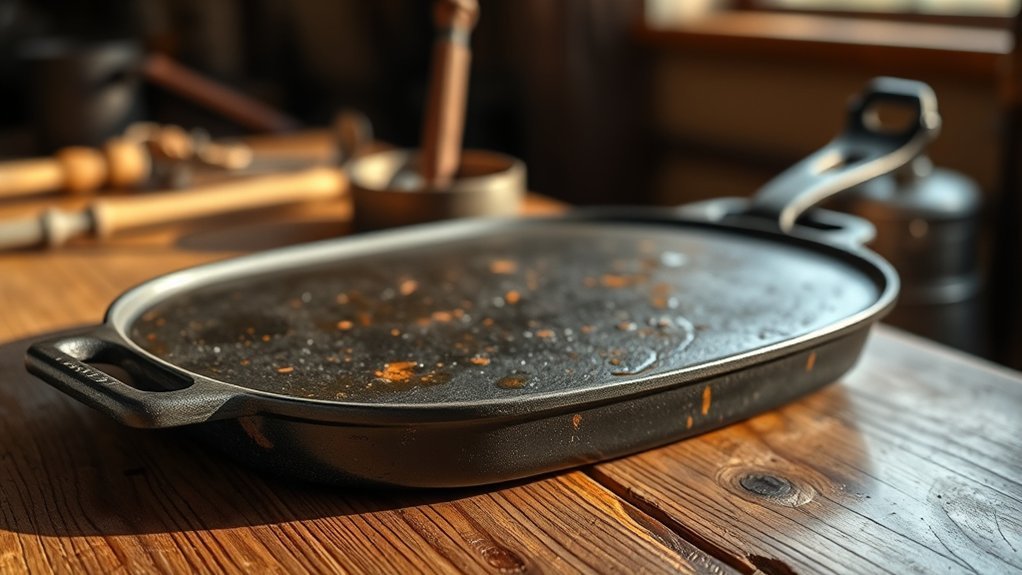
- Cast iron excels in heat retention but requires seasoning to prevent rust.
- Aluminum offers rapid heating and lighter weight but can warp under high heat.
- Stainless steel resists corrosion and is easier to clean but may have uneven heat distribution.
- Non-stick coatings on modern griddles improve convenience but reduce lifespan.
Understanding these factors helps you select the ideal griddle material for your needs.
Cooking Efficiency Comparison
When comparing cooking efficiency between traditional and modern griddles, what factors should you prioritize? You need to consider heat distribution, temperature control, energy use, and maintenance. Traditional griddles, often steeped in historical myths and shaped by regional cookware styles, excel in durability but lack precise temperature control.
Modern griddles offer advanced heat management and energy efficiency but may sacrifice longevity.
| Factor | Traditional Griddles |
|---|---|
| Heat Distribution | Uneven, depends on material |
| Temperature Control | Limited, manual adjustments |
| Energy Efficiency | Lower, uses open flames |
| Maintenance | Simple, requires seasoning |
| Durability | High, cast iron or steel |
Understanding these differences helps you choose the best griddle for efficient cooking.
Why Griddles Are Essential Tools in Modern Kitchens
Why do griddles remain indispensable in modern kitchens despite the abundance of cooking appliances today? You’ll find their unique design, often featuring a rough texture, enhances flavor preservation by allowing food to sear evenly and lock in juices. Their versatility and efficiency make them essential.
- Even Heat Distribution: Griddles provide consistent heat, ensuring uniform cooking without hot spots.
- Large Cooking Surface: You can prepare multiple items simultaneously, saving time and energy.
- Flavor Preservation: The rough texture helps sear food, retaining natural juices and enhancing taste.
- Easy Cleanup: Non-stick or seasoned surfaces simplify maintenance, making them practical for daily use.
Tips for Choosing the Best Griddle for Your Cooking Style
What features should you prioritize to find a griddle that perfectly matches your cooking style? Start by considering material, size, and heat source. Griddles vary widely, reflecting their cultural origins and even ancient myths about cooking tools.
For example, cast iron is ideal for high heat and durability, while electric models offer precision and ease. Size depends on your typical meal portions and kitchen space.
| Feature | Benefit | Ideal For |
|---|---|---|
| Material | Heat retention & durability | Cast iron, stainless steel |
| Size | Cooking volume | Small to large surfaces |
| Heat Source | Control & convenience | Gas, electric, induction |
| Portability | Flexibility in use | Lightweight, compact |
| Surface Type | Food release & cleaning | Non-stick, smooth steel |
Choose wisely to honor the rich history behind griddles and enhance your cooking experience.
Frequently Asked Questions
How Do You Clean and Maintain a Griddle Effectively?
You should clean your griddle after every use to prevent buildup and schedule deep cleaning weekly.
Regular maintenance scheduling includes seasoning the surface to avoid rust and checking gas connections to ensure safety and optimal performance.
What Are the Best Foods to Cook on a Griddle?
You’ll love cooking the best breakfasts like pancakes, eggs, and bacon, sizzling street foods such as quesadillas and sliders, and searing vegetables. The griddle’s even heat makes these foods cook evenly and develop rich flavors.
Can Griddles Be Used for Outdoor Cooking?
Yes, you can use griddles for outdoor cooking. Their history shows versatility, and they offer outdoor cooking advantages like even heat distribution, large surface area, and quick cleanup.
These features make them perfect for grilling and breakfast outdoors.
Are Electric Griddles Energy Efficient?
Yes, electric griddles offer strong electric efficiency by heating quickly and evenly. Compared to stovetops, their energy comparison shows less wasted heat, making them a more energy-efficient choice for consistent cooking.
How Do Griddles Compare to Frying Pans in Cooking Speed?
You’ll notice griddle speed differences mainly come from its larger surface, cooking more food simultaneously, while frying pan efficiency shines in quicker heat adjustments and focused cooking. Each suits different meal prep needs effectively.
Conclusion
You can clearly see that griddles grew gradually, gaining global ground through generations, grounded in diverse cultures. No single soul solely sculpted this simple, sturdy staple. Instead, innovations ignited improvements, influencing modern materials and methods.
As you choose your cooking companion, consider how tradition and technology together transform your kitchen craft. Understanding this shared story sharpens your selection, ensuring you savor sizzling success with every meal made on your mighty, modern griddle.
In the end, knowing who invented the griddle adds depth to your appreciation of this timeless cooking tool.