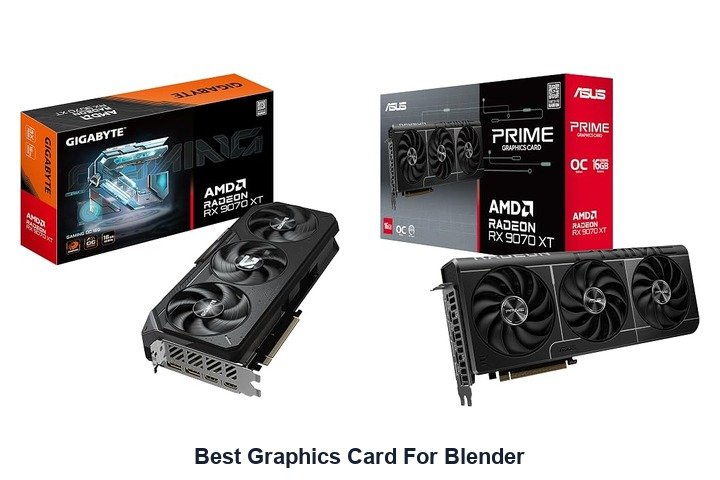

The best graphics card for blender is a critical component for artists and designers aiming to enhance rendering efficiency and visual precision in 3D modeling. With rapid advancements in GPU technology, understanding how to select a graphics card that accelerates cycles rendering, supports high VRAM capacity, and integrates seamlessly with Blender’s viewport can significantly impact productivity. Whether handling complex simulations or detailed animations, the right GPU influences performance in both interactive previews and final output.
Exploring the nuances of CUDA cores, ray tracing acceleration, and memory bandwidth can illuminate why some graphics cards outperform others in Blender workloads. This guide delves into the key features and innovations shaping the best graphics card for blender, providing insights to help refine your hardware choice and elevate your creative projects.
best graphics card for blender: Top Picks for 2026
| Image | Product | Buy |
|---|---|---|
Top Picks- 1  | GIGABYTE Radeon RX 9070 XT Gaming OC 16G Graphics Card, Best for: High-performance gaming | Check Price On Amazon |
Top Picks- 2  | ASUS Prime Radeon RX 9070 XT 16GB GDDR6 OC Edition Best for: Reliable overclocking | Check Price On Amazon |
Top Picks- 3  | PNY NVIDIA Quadro RTX 4000 – The World’S First Ray Best for: Professional visualization | Check Price On Amazon |
Top Picks- 4  | NVIDIA GeForce RTX 4070 Founder’s Edition (FE) Graphics Card – Best for: Enthusiast creators | Check Price On Amazon |
Top Picks- 5  | ASUS TUF Gaming GeForce RTX™ 5080 16GB GDDR7 OC Edition Best for: Top-tier rendering | Check Price On Amazon |
1. GIGABYTE Radeon RX 9070 XT Gaming OC 16G Graphics Card,
Best for: Powerful AMD GPU with advanced cooling.
Equipped with a 16GB GDDR6 memory and an impressive 3060 MHz GPU clock speed, the GIGABYTE Radeon RX 9070 XT Gaming OC enables complex Blender scenes to render swiftly and smoothly thanks to its server-grade thermal conductive gel and the TWINDFORCE cooling system.
Supporting a maximum resolution of 7680 x 4320 and using a PCI-Express x16 interface, this card provides high-fidelity visuals and rapid data transfer rates ideal for detailed 3D modeling and high-resolution rendering. The built-in Hawk Fan design enhances airflow, maintaining stability under prolonged workloads.
Pros
- 16GB GDDR6 memory for large texture handling
- 3060 MHz GPU clock speed enabling fast render cycles
- TWINDFORCE cooling system with thermal conductive gel reduces overheating
- Supports ultra-high 7680 x 4320 display resolution for detailed previews
Cons
- Single DisplayPort interface limits multi-monitor setups
Ideal for Blender artists seeking robust AMD performance in demanding projects. The combination of high memory and superior cooling ensures long sessions without thermal throttling.
2. ASUS Prime Radeon RX 9070 XT 16GB GDDR6 OC Edition
Best for: Efficient cooling and reliable performance.
The ASUS Prime Radeon RX 9070 XT OC Edition features innovative Axial-tech fans with extended blades and a barrier ring that generates higher downward air pressure, enhancing GPU cooling for consistent Blender performance during intensive rendering tasks.
With 16GB of GDDR6 RAM and a GPU clock speed of 3030 MHz, this card operates seamlessly at resolutions up to 7680 x 4320. Its 2.5-slot design balances compactness with effective thermal management. Dual-ball bearing fans increase spine-long durability, maintaining stable operation over time.
Pros
- 16GB GDDR6 RAM for handling complex scenes
- 3030 MHz GPU clock speed for reactive processing
- Dual-ball fan bearings for extended lifespan
- 0dB technology ensures silent operation under low loads
Cons
- 3-fan cooling increases size, may challenge smaller cases
Perfect for creators valuing steady thermal performance and quiet operation in Blender workflows. Its durability and efficient heat dissipation make it suitable for long hours of 3D rendering.
3. PNY NVIDIA Quadro RTX 4000 – The World’S First Ray
Best for: Professional-grade NVIDIA ray-tracing GPU.
Featuring the NVIDIA Quadro RTX 4000 with 8GB GDDR6 memory and specialized RTX cores, this card delivers real-time ray tracing and photorealistic rendering essential for professional Blender users working on detailed lighting and shading.
With a maximum display resolution of 3840 x 2160 and integration of NVIDIA’s Turing architecture, this card accelerates rendering times through 36 RT cores and advanced shading features. Its PCI-Express x16 interface ensures swift communication with the CPU for interactive workflows.
Pros
- Ray-tracing optimized with 36 RT cores
- 8GB GDDR6 memory suitable for professional tasks
- Advanced rendering features for immersive VR applications
- Single-fan design reduces noise
Cons
- 8GB RAM may limit ultra-high-poly projects
Best suited for professionals who prioritize ray-traced rendering in Blender with moderate memory needs. Its architecture supports advanced visuals while maintaining smooth viewport interactivity.
4. NVIDIA GeForce RTX 4070 Founder’s Edition (FE) Graphics Card –
Best for: High CUDA core count with efficient architecture.
Powered by an NVIDIA GeForce RTX 4070 GPU featuring 5,888 CUDA cores and a 2.48 GHz boost clock, this Founder’s Edition card excels at accelerating Blender’s CUDA-based rendering and complex shader computations.
It comes with 12GB of GDDR6X memory and supports resolutions up to 8K (4320p). Utilizing PCI Express 4.0 compatibility, it offers faster bandwidth for data flow and supports NVIDIA DLSS and Studio Drivers to enhance creative performance and quality.
Pros
- 5,888 CUDA cores for faster parallel processing
- 12GB GDDR6X memory balancing speed and capacity
- PCI Express 4.0 interface for high data throughput
- Supports advanced NVIDIA Studio Drivers for Blender
Cons
- 12GB memory may be limiting for extremely large scenes
An excellent match for Blender users focused on CUDA ray tracing and AI denoising with moderate memory requirements. It suits those seeking efficient performance with the latest generation’s architecture.
5. ASUS TUF Gaming GeForce RTX™ 5080 16GB GDDR7 OC Edition
Best for: Top-tier NVIDIA GPU with next-gen memory.
The ASUS TUF Gaming GeForce RTX 5080 brings 16GB of ultra-fast GDDR7 memory paired with NVIDIA’s Blackwell architecture to deliver powerful Blender rendering capabilities with enhanced durability thanks to military-grade components.
Operating at a GPU clock speed of 2730 MHz with a 348mm length and a 3.6-slot form factor, it requires careful case compatibility consideration. Protective PCB coating shields against moisture and dust, while 3.6-second fan stop technology lowers noise for less intrusive workflow sessions.
Pros
- 16GB GDDR7 memory for handling demanding textures
- Military-grade components ensure reliability
- Protective PCB coating reduces risk of short circuits
- 3.6-second fan stop tech minimizes noise during idle
Cons
- Large 348mm length may not fit all PC cases
Recommended for Blender professionals with ample case space who want a durable, high-performance GPU for complex scenes and long rendering tasks enhanced by Blackwell architecture.
6. GIGABYTE GeForce RTX 5070 Ti Gaming OC 16G Graphics Card,

Best for: High memory bandwidth and advanced cooling.
GIGABYTE’s RTX 5070 Ti Gaming OC features 16GB of GDDR7 memory with a 256-bit memory interface and a 2600 MHz GPU clock, providing fast data processing and exceptional thermal regulation via the WINDFORCE cooling system.
Supporting 7680 x 4320 resolution and PCI-Express x16, this card is built for detailed Blender workloads. It deploys three fans for improved heat dissipation, helping maintain peak performance during sustained rendering sessions without throttling.
Pros
- 16GB GDDR7 memory for smooth multitasking
- 256-bit memory interface for wide data lanes
- WINDFORCE cooling system with triple fans
- Supports ultra-high 7680 x 4320 resolution
Cons
- 2600 MHz clock speed is mid-range for RTX 50 series
Ideal for Blender artists seeking a balance between high memory and efficient cooling in demanding renders. Recommended for users prioritizing thermal stability during long projects.
7. GIGABYTE GeForce RTX 5060 WINDFORCE OC 8G Graphics Card, Cooling

Best for: Compact card with next-generation memory.
The GIGABYTE GeForce RTX 5060 WINDFORCE OC uses 8GB of high-speed GDDR7 memory on a 128-bit interface paired with a GPU clock of 2512 MHz, delivering capable Blender performance in a smaller form factor.
This card supports resolutions up to 7680 x 4320 with PCI-Express x16 compatibility. Its WINDFORCE dual-fan cooling system ensures effective heat dissipation necessary for consistent rendering. The PCIe 5.0 interface allows readiness for upcoming motherboard standards.
Pros
- GDDR7 memory for improved data speeds
- Dual-fan WINDFORCE cooling reduces heat efficiently
- Supports 7680 x 4320 ultra-high resolutions
- PCIe 5.0 ready for next-gen integration
Cons
- 8GB memory may be restrictive for large-intensive projects
Well-suited for Blender users with space constraints who still want modern memory and reliable cooling. Best for moderate complexity scenes and efficient workstation builds.
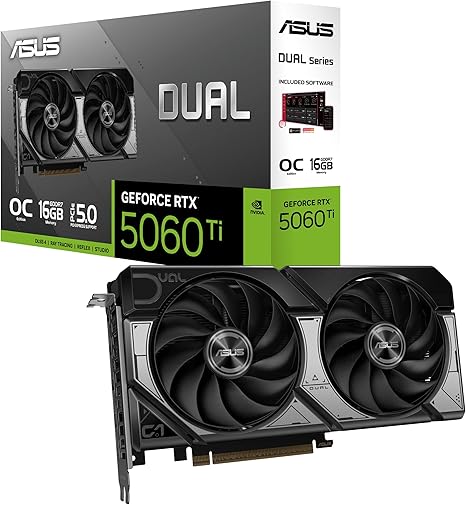
8. ASUS Dual GeForce RTX 5060 Ti 16GB GDDR7 OC Edition
Best for: Optimized cooling in compact chassis.
ASUS Dual GeForce RTX 5060 Ti OC Edition combines 16GB of GDDR7 memory with a GPU clock speed up to 2632 MHz and axial-tech fans with a barrier ring, optimizing airflow for Blender workloads in smaller build environments.
This 2.5-slot card supports a display resolution of 7680 x 4320, utilizing PCI-Express x16 for high-speed data connectivity. Its dual BIOS feature allows toggling between silent and performance modes, giving users control over noise and power efficiency during projects.
Pros
- 16GB GDDR7 memory for large scenes
- Axial-tech fan design with enhanced airflow
- Dual BIOS for flexible performance/noise settings
- Supports 7680 x 4320 ultra-high resolutions
Cons
- Only two fans may limit cooling in extreme workloads
Tailored for Blender creators wanting powerful memory and tunable cooling in a smaller form factor. Perfect for those balancing system noise and rendering power.
9. ASUS Dual Radeon RX 9060 XT 16GB GDDR6 Gaming Graphics

Best for: Reliable AMD card with enhanced longevity.
ASUS Dual Radeon RX 9060 XT offers 16GB of GDDR6 memory with a high 3250 MHz GPU clock speed and axial-tech fans that improve thermal performance while preserving quiet operation during Blender sessions.
With a 2.5-slot design and dual ball-bearing fans, longevity and compatibility are priorities. It supports up to 7680 x 4320 resolution and features a dual BIOS for switching performance modes, helping artists adapt cooling to project loads.
Pros
- High 3250 MHz GPU clock speed for quick rendering
- 16GB GDDR6 memory for demanding workloads
- Dual ball fan bearings double cooling lifespan
- Dual BIOS enables user-defined cooling and performance
Cons
- Only two DisplayPort outputs limit multi-display options
Best for Blender users who want a fast AMD card with robust cooling and quiet operation. Suitable for those needing sustained speed and reliability in everyday renders.
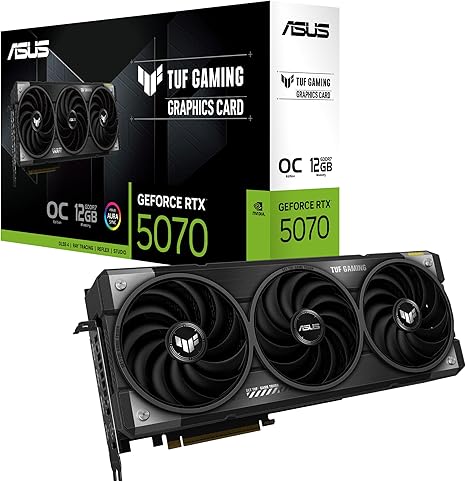
10. ASUS TUF Gaming GeForce RTX 5070 12GB GDDR7 OC EditionGaming
Best for: Durable GPU with extensive cooling array.
The ASUS TUF Gaming GeForce RTX 5070 OC Edition offers 12GB of GDDR7 memory combined with a 2640 MHz boost clock and a massive 3-fan cooling system incorporating a large fin array to maintain stable Blender rendering performance.
Thanks to phase-change thermal pads and military-grade components, this card ensures long-term durability and consistent thermal transfer. It uses a 3.125-slot design and supports 7680 x 4320 resolution, ideal for handling detailed models and animations.
Pros
- 12GB GDDR7 memory balances speed and capacity
- Three Axial-tech fans with large fin array optimize cooling
- Military-grade components improve durability
- Phase-change thermal pads enhance heat dissipation
Cons
- 3.125-slot size requires ample case space
Perfect for Blender enthusiasts needing a durable GPU with effective cooling for extended operation. Best in builds that accommodate slightly larger dimensions for robust thermal management.
How to Choose the Right Best Graphics Card for Blender
Performance and rendering speed
For Blender users prioritizing rendering speed, selecting a graphics card with a high count of CUDA cores is essential, as these cores directly accelerate GPU rendering tasks. Beyond core count, clock speeds significantly influence performance, with faster GPUs processing frames and tasks more rapidly, enhancing workflow efficiency. VRAM size crucially impacts the handling of intricate scenes; a minimum of 8GB VRAM is necessary for moderate workloads, while 12GB or more ensures smooth operation with large, detailed projects.
Buyers focused on quick render times and complex projects should opt for a GPU featuring at least 3000 CUDA cores, clock speeds above 1.5 GHz, and 12GB or more VRAM to guarantee seamless performance.
Compatibility and software support
Blender demonstrates a clear preference for NVIDIA GPUs due to their extensive support for CUDA, which accelerates rendering and simulation processes. NVIDIA’s frequent driver updates provide stable and robust software integration, minimizing crashes and bugs. Furthermore, NVIDIA’s hardware excels in ray tracing and viewport acceleration, enabling realistic lighting and faster viewport navigation.
Buyers aiming for maximum compatibility and smooth Blender operation must choose NVIDIA graphics cards with dedicated ray tracing cores and maintained driver support, as these cards offer unmatched performance and stability within Blender’s ecosystem.
Thermal management and cooling solutions
Effective thermal management in a GPU ensures sustained performance during prolonged Blender rendering sessions. Air cooling solutions provide straightforward maintenance and quieter operation, provided the card includes multiple fans and efficient heat sinks. Liquid cooling systems, while often quieter and more capable of maintaining lower temperatures under load, require additional setup and periodic maintenance.
Buyers needing a quiet workstation for extended render times should select a card with a high-quality air cooling system featuring at least two fans and low decibel noise output, whereas those focused on extreme performance may prefer liquid-cooled GPUs that offer superior heat control without thermal throttling during intense tasks.
Power consumption and psu requirements
High-performance GPUs for Blender can demand upwards of 250 watts, necessitating a power supply that accommodates these requirements with appropriate PCIe connectors, typically 6-pin or 8-pin variants. Ensuring your PSU can deliver stable power at or above these levels is critical to maintain system stability during rendering. Energy efficiency varies among GPUs; selecting models with higher performance-per-watt ratios reduces operational costs and thermal output without sacrificing speed.
Buyers should verify their PSU wattage matches or exceeds the recommended power draw and prioritize cards that balance power consumption with output efficiently, safeguarding both performance and energy usage.
Price and value for performance
Balancing investment and capability is vital when choosing a Blender graphics card. Cards with solid reputations for long-term reliability backed by comprehensive warranty coverage offer the best value despite higher initial costs. Avoid undervaluing upfront investment, as durable GPUs maintain performance consistency and reduce replacement frequency.
For those seeking sustained productivity and minimal downtime, selecting GPUs known for dependable build quality coupled with comprehensive manufacturer warranties ensures the optimal harmony between cost and durable performance.
Which Should You Choose?
- If you need strong cooling for intensive Blender rendering tasks, choose a graphics card with advanced multi-fan systems and thermal optimization features.
- If you prioritize professional-grade ray tracing and real-time viewport performance, choose a workstation GPU with dedicated RT cores and optimized drivers for creative applications.
- If you want cutting-edge AI acceleration and DLSS support for faster workflow, choose a card built on the latest architecture that includes AI-powered rendering enhancements.
- If you have a limited power supply or prefer a compact build, choose a graphics card with efficient power consumption and a smaller form factor while maintaining sufficient VRAM for complex scenes.
Quick Best Graphics Card For Blender Buying Checklist
- CUDA Cores: Ensure the GPU has ample CUDA cores for efficient Blender rendering.
- VRAM Capacity: Opt for at least 8GB to handle detailed 3D models and textures.
- Driver Compatibility: Confirm the card supports the latest Blender updates and drivers.
- Cooling System: Choose a graphics card with advanced cooling to maintain performance under load.
- Power Requirements: Verify your power supply can support the GPU’s wattage and connectors.
- Price vs. Performance: Look for a balance that suits your budget without sacrificing key features.
Frequently Asked Questions
What Is The Importance Of Vram In A Graphics Card For Blender?
VRAM is crucial for Blender because it stores textures, models, and data during rendering, directly affecting performance. More VRAM allows handling larger projects without slowdowns or crashes, especially with complex scenes or high-resolution assets.
Are Nvidia Or Amd Graphics Cards Better For Blender?
NVIDIA cards are generally better for Blender due to CUDA support, which Blender’s Cycles renderer utilizes for faster computation. AMD cards can work well but may lack optimized driver support and CUDA acceleration for certain features.
How Does Cooling Affect The Performance Of A Graphics Card In Blender?
Effective cooling prevents overheating and thermal throttling, ensuring the graphics card operates at peak speeds during long rendering sessions. Good cooling solutions maintain stability, which is essential for consistent Blender performance.
Is Power Consumption A Critical Factor When Choosing A Graphics Card For Blender?
Yes, power consumption matters because high-performance GPUs draw significant watts, requiring a compatible power supply and affecting electricity costs. Efficient cards help maintain system stability and reduce energy expenses during extended use.
How Does Driver Support Influence The Choice Of A Graphics Card For Blender?
Driver support directly impacts stability and feature compatibility with Blender. Frequent updates and reliable drivers improve rendering speed and prevent crashes, making this a key factor when selecting a GPU.
Final Suggestions
Choosing the best graphics card for Blender enhances your 3D modeling and rendering efficiency with faster processing and improved visuals. These GPUs provide the versatility needed for complex projects and smooth workflows. Investing in the right graphics card empowers you to unlock Blender’s full creative potential and handle demanding tasks with confidence.