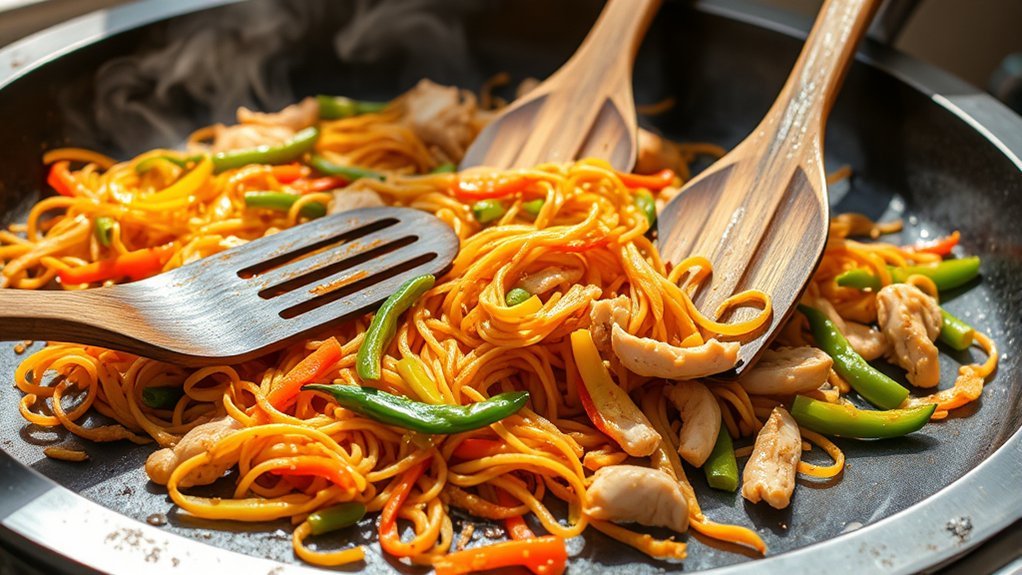

When cooking lo mein noodles on your Blackstone griddle, selecting the right noodles and controlling heat are essential for achieving the ideal texture and flavor. Lo mein noodles require careful attention to timing to avoid sogginess or burning, while ensuring even caramelization.
Mastering these steps will elevate your lo mein beyond ordinary stir-fry dishes. Understanding the process begins with how to prepare your griddle and ingredients properly.
By managing heat and cooking time, you can create a delicious, perfectly cooked lo mein right on your Blackstone griddle.
Key Takeaways
- Preheat the Blackstone griddle to medium-high (350-400°F) for even cooking and ideal noodle texture.
- Clean and oil the griddle surface to maintain non-stick seasoning and prevent sticking.
- Spread vegetables evenly first, then add fresh or quality dried lo mein noodles, separating with tongs.
- Pour sauce over the mixture after noodles and veggies are heated, stirring continuously for caramelization.
- Avoid overcrowding and maintain medium-high heat to prevent soggy noodles and ensure flavor melding.
How To Choose The Right Lo Mein Noodles
How do you select the perfect lo mein noodles for cooking on a Blackstone griddle? Start by focusing on noodle texture, a critical factor that influences cooking performance and final dish quality. You want noodles that maintain firmness yet remain pliable under high heat; fresh or high-quality dried wheat noodles work best.
Avoid overly thin or fragile varieties, as they break apart quickly during griddle cooking. When considering two word discussion ideas, “texture integrity” and “heat resilience” are key. Texture integrity ensures the noodles don’t become mushy, while heat resilience allows even cooking without sticking or tearing.
Choose noodles labeled specifically for lo mein or stir-fry applications to align with these technical requirements, ensuring optimal results on your Blackstone griddle.
Prepare Your Blackstone Griddle
Start by thoroughly cleaning your Blackstone griddle to remove any residue that could affect flavor or cooking performance.
Next, preheat the griddle to a consistent medium-high temperature, around 350°F to 375°F, for optimal noodle searing. Proper preparation ensures even cooking and prevents sticking during your lo mein process.
Griddle Cleaning Tips
Why does maintaining a clean Blackstone griddle matter before cooking lo mein noodles? Proper griddle maintenance ensures consistent heat distribution, preventing hot spots that could unevenly cook your noodles.
Residual debris or grease can alter the noodle texture, making them soggy or burnt rather than perfectly tender with a slight bite. Start by scraping the griddle surface with a metal spatula to remove stuck-on food.
Then, apply a small amount of water to deglaze and loosen any remaining particles, wiping clean with a heat-resistant cloth. Avoid harsh detergents that can damage the seasoning layer.
Finally, re-season the griddle with a thin oil coat to protect the surface and maintain its non-stick properties. This disciplined cleaning routine preserves your griddle’s performance and optimizes noodle quality every time.
Preheating Temperature Guide
Consistently preheating your Blackstone griddle to the correct temperature is essential for achieving ideal cooking results when making lo mein noodles. Proper temperature preheat ensures even cooking and optimal noodle textures, preventing sogginess or burning.
Follow this precise guide:
- Preheat the griddle to 350°F for moderate heat, ideal for sautéing vegetables and softening noodles without overcooking.
- Increase to 400°F for stir-frying protein and achieving a slight crisp on noodles, enhancing texture contrast.
- Maintain steady heat to avoid temperature fluctuations that disrupt cooking consistency and noodle textures.
Must-Have Ingredients For Great Lo Mein
What key ingredients define an authentic and flavorful lo mein? You need fresh egg noodles, which provide the ideal texture and absorb the sauce effectively. Soy sauce, both light and dark, delivers essential umami and color.
Incorporate aromatics like garlic and ginger for depth. Crisp vegetables such as bok choy, bell peppers, and scallions add texture and vibrancy. Protein options like sliced chicken, beef, or tofu offer substance without overpowering.
These must-have ingredients form the foundation for great lo mein and ensure Subtopic relevance by targeting core flavors and textures. This two word discussion ideas approach, “ingredients selection,” guides your preparation, guaranteeing consistency and authenticity without prematurely delving into sauce formulation, which is reserved for the next subtopic.
How To Make The Best Lo Mein Sauce
How do you achieve the perfect balance in lo mein sauce? Focus sharply on three critical factors to master sauce consistency and flavor depth.
- Soy Sauce Base: Use a high-quality soy sauce for umami depth. For gluten free options, substitute tamari without sacrificing complexity.
- Sweetness and Acidity: Balance the saltiness with a measured amount of sugar and rice vinegar. This stabilizes the sauce consistency and prevents overpowering saltiness.
- Thickening Agent: Incorporate cornstarch slurry gradually to reach a glossy, clingy texture that coats noodles evenly without pooling.
Precision in ratios is key. Too much liquid thins the sauce; too little makes it pasty. Always whisk the ingredients thoroughly to integrate flavors uniformly. By controlling these elements, you ensure your lo mein sauce is robust, balanced, and perfectly suited for cooking on your Blackstone griddle.
Step-By-Step Guide To Cooking Lo Mein On Your Blackstone
Start by prepping all your ingredients to guarantee even cooking and quick assembly.
Next, focus on cooking the noodles uniformly on your Blackstone griddle to achieve the ideal texture.
Finally, incorporate the sauce thoroughly, mixing everything evenly for consistent flavor distribution.
Preparing Ingredients Properly
When preparing ingredients for lo mein on your Blackstone griddle, timing and uniformity are critical. Achieving perfect ingredient timing requires strict topic isolation. Each element must be prepped to cook evenly without overlap. Follow these steps:
- Cut all vegetables and proteins into uniform sizes, ensuring they cook at the same rate and prevent uneven texture.
- Measure and portion sauces and liquids separately to add at precise moments, maintaining control over flavor balance.
- Par-cook noodles if needed, draining thoroughly to avoid excess moisture that disrupts the griddle’s high heat.
Cooking Noodles Evenly
With your ingredients prepped to consistent sizes and sauces measured, you can focus on cooking the noodles evenly on your Blackstone griddle. First, preheat the griddle to medium-high, ensuring precise heat control to avoid scorching or undercooking.
Spread the noodles evenly across the surface, separating any clumps to promote uniform contact. Toss the noodles gently but consistently, using a spatula to lift and turn them, ensuring every strand reaches the same temperature.
Maintain this motion to achieve an ideal texture balance: tender with slight chewiness without overcooking. Monitor the griddle temperature closely, adjusting heat as needed to prevent sticking or drying out.
This disciplined approach guarantees your lo mein noodles cook evenly, setting a solid foundation before adding sauce and mix-ins.
Adding Sauce And Mix
Although the noodles are cooked evenly, you’ll need to incorporate the sauce and mix-ins promptly to preserve their texture and flavor balance. Avoid overcooking noodles at this stage, as excess heat will degrade their firmness. Focus on achieving proper sauce emulsification to coat the noodles evenly without pooling.
Follow these steps:
- Pour the sauce evenly over the noodles on the hot griddle.
- Quickly add your chosen mix-ins, such as vegetables, proteins, or aromatics, distributing them uniformly.
- Using a spatula, fold and toss the noodles and mix-ins continuously to promote emulsification and prevent sticking.
This method ensures the sauce adheres correctly while maintaining noodle integrity, resulting in a restaurant-quality lo mein with balanced flavor and perfect texture.
Tips For Stir-Frying Veggies And Proteins On Blackstone
How do you guarantee your veggies and proteins cook evenly and develop ideal flavor on a Blackstone griddle? Master stir fry timing and heat control. Preheat your griddle to medium-high, ensuring even heat distribution.
Add proteins first; they need longer cooking times. Once proteins reach proper doneness, push them aside and add veggies, which require shorter cooking intervals. Stir frequently to prevent scorching and promote uniform cooking.
| Tip | Explanation |
|---|---|
| Heat Control | Maintain medium-high for balanced sear |
| Stir Fry Timing | Sequence proteins before veggies |
| Ingredient Prep | Cut uniform sizes for even cooking |
| Constant Movement | Toss regularly to avoid hotspots |
How To Customize Your Lo Mein With Proteins And Veggies
What proteins and vegetables complement your Lo Mein best? Selecting the right combination enhances texture and flavor while balancing the spice level to your preference. Start by choosing proteins or protein substitutes that cook evenly on your Blackstone griddle.
- Chicken, shrimp, or tofu. These provide diverse textures; tofu serves as an excellent protein substitute with a neutral flavor that absorbs sauces well.
- Bell peppers, snap peas, and bok choy. Crisp vegetables add freshness and contrast to noodles.
- Adjust spice level by incorporating fresh chili slices or chili oil during cooking for controlled heat intensity.
Customize your ingredients thoughtfully to maintain optimal cooking times and achieve a harmonious bite without overwhelming the dish.
Final Steps: Combining Noodles, Veggies, And Sauce On The Griddle
Where do you begin when combining your cooked noodles, vegetables, and sauce on the Blackstone griddle? Start by spreading the veggies evenly and heating them briefly. Add the noodles next, using tongs to separate and distribute them uniformly.
Pour the sauce over the mixture, ensuring it coats everything without pooling. Maintain medium-high heat to allow rapid caramelization and flavor melding.
| Step | Action | Purpose |
|---|---|---|
| 1. Veggies | Spread evenly | Consistent heat exposure |
| 2. Noodles | Separate, distribute | Prevent clumping |
| 3. Sauce | Pour, coat | Even flavor distribution |
| 4. Stir | Toss continuously | Integrate ingredients fast |
Avoid two word discussion ideas unrelated to this subtopic to maintain focus on precise final steps.
Common Mistakes When Cooking Lo Mein On Blackstone
Mastering the final combination of noodles, veggies, and sauce on your Blackstone sets the stage for success, but even experienced cooks stumble over common pitfalls that can compromise texture and flavor. Avoid these mistakes to ensure optimal results:
- Overcrowding Griddle: Crowding lowers heat, causing uneven cooking and soggy noodles. Maintain space for proper searing.
- Incorrect Heat: Too high heat burns noodles; too low prevents caramelization. Use medium-high, adjusting as needed.
- Neglecting Sauce Timing: Adding sauce too early or late disrupts coating consistency. Incorporate sauce after noodles and veggies are hot and nearly done.
These two word discussion ideas, “overcrowding” and “heat control,” are critical, while other subtopic irrelevant errors often stem from inexperience. Focus sharply on these factors to perfect your lo mein on the Blackstone.
Cleaning And Maintaining Your Blackstone Griddle
Regularly cleaning and maintaining your Blackstone griddle ensures consistent cooking performance and prolongs its lifespan. Establish a strict cleaning schedule by scraping food debris immediately after each use with a metal spatula and wiping the surface with a damp cloth. Avoid using soap; instead, apply a thin layer of oil to preserve the griddle seasoning.
After every cooking session, heat the griddle to burn off residue, then apply a fresh coat of oil to maintain the non-stick surface and prevent rust. Periodically, perform a deep clean by heating the griddle, scraping thoroughly, and reseasoning the surface with high-smoke-point oil.
Adhering to this cleaning schedule and proper griddle seasoning technique will keep your Blackstone griddle in top condition for cooking lo mein noodles and beyond.
Frequently Asked Questions
Can I Use Frozen Lo Mein Noodles on a Blackstone Griddle?
Yes, you can use frozen noodles on your griddle, but ensure you separate them first to avoid clumping.
Maintain griddle safety by preheating properly and avoiding moisture buildup to prevent splattering and uneven cooking.
What Is the Best Type of Oil for Cooking Lo Mein on a Griddle?
The best oil for lo mein on a griddle is peanut or canola oil; they handle high oil temperatures like a seasoned conductor directing heat. Maintain oil temperature around 375°F for optimal searing and flavor infusion.
How Long Does It Take to Cook Lo Mein Noodles on a Blackstone?
You’ll spend about 5-7 minutes cooking lo mein noodles on your Blackstone, carefully managing griddle heat to achieve optimal cooking noodle texture, tender but firm.
Stir consistently to prevent sticking and ensure even heat distribution.
Can I Make Lo Mein Noodles Gluten-Free on a Blackstone Griddle?
Yes, you can make lo mein gluten-free on a Blackstone. Use gluten-free substitutions like rice or soba noodles, ensure gluten-free sauces, and strictly follow cross contact precautions by thoroughly cleaning the griddle before cooking.
Is It Safe to Cook Other Asian Dishes on the Same Griddle After Lo Mein?
Yes, it is safe to cook other dishes on the same griddle after lo mein, provided you thoroughly clean the surface to prevent cross-contamination and flavor transfer. This ensures optimal food safety and preserves the integrity of each dish.
Conclusion
Cooking lo mein on your Blackstone griddle is like conducting a precise symphony—each step harmonizes for perfect texture and flavor. By choosing the right noodles, prepping the griddle properly, and balancing sauce with fresh ingredients, ensure consistent, professional results. Avoid overcrowding and stir constantly to maintain that ideal caramelization.
With practice, your lo mein will consistently deliver a satisfying, restaurant-quality meal right from your griddle every time. Mastering these techniques is key to successful lo mein on Blackstone griddle.